

I decided to single-handedly save the monarch population in a single season; you can now refer to me as Monarch Mommy™
This, of course, is a joke (the saving the species part, not the Monarch Mommy™ part), and since raising monarchs indoors can be quite a hot top on the internet (who knew, right?), I’m going to start this post with a clear disclaimer: apparently it’s not been proven that indoor rearing of monarchs has done much — if anything — to help the general monarch population.
Some studies say that, if done improperly, the indoor raising of monarch butterflies can actually have an adverse effect on the general monarch population.
*steps onto my soapbox*
Let me just say that I completely agree with some reasonings (like it can make spreading disease easier), while other reasonings I completely disagree with. For instance, believing that nature successfully “picks off the weak” and that we’re interfering with that process by protecting them?? Um, here’s my hot take: having a wasp lay eggs in a caterpillar doesn’t mean that a caterpillar is weak, it just means that it was one unlucky little dude who now has to endure a horrific death!


I believe that my butterflies were part of the migratory generation (also known as the “super generation”), and they were much larger than other monarchs that I’ve seen around
a quick hot take
When it comes to raising butterflies inside: dirty or small growing environments, spreading of disease and/or parasites, improper lighting, and dramatic temperature fluctuations can all have negative effects on the little ‘pillars (and the butterflies they become).
We all know that humans can be extremely irresponsible, and I’ve seen plenty of people online raising these caterpillars in jars or tupperware containers — which I consider to be quite sad, if not outright cruel. Not only is it unkind to the caterpillar to give it so little room to move and grow, it can actually produce smaller caterpillars, which in turn produce smaller butterflies!
Big, healthy butterflies need room to grow!!

But I simply do not fully agree with the people atop their high horses preaching “leave nature alone! Let nature take its course!” and leaving it at that. I find that this is typically a very hypocritical approach, because how often do humans interfere with nature and get praised for helping, and yet when it comes to raising a few butterflies inside it’s suddenly morally wrong? Have y’all ever been to a zoo? An aquarium? Have you seen what humans do to keep wild albatross chicks, pandas, and California condors alive…?
With the current trend of what humans are doing to the environment, and the fact that we are losing millions (possibly billions) of birds, and trillions (yes, trillions) of invertebrates per year, nature is not always able to take care of things on its own. Because humans are constantly damaging it!
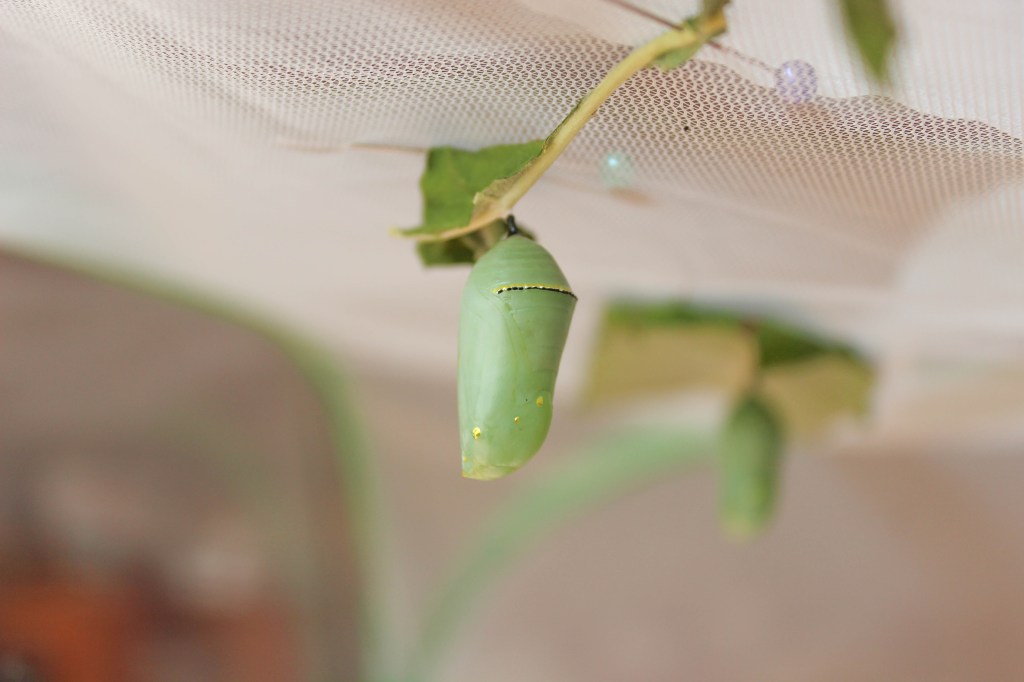
Monarchs are not in decline because of the monarchs’ lack of ability to reproduce, grow, and thrive, monarchs are in decline because of what humans are doing to the environment that they depend on.
And because of people’s lame arguments about interfering with nature, I’ve seen some people who were shamed into not bringing their precious monarch caterpillars inside, only to have them all die when their town sprayed pesticides up and down the street.
*slow clap*
Ah, yes, that really picked off the weak.
I do believe that the best things we can do to help these declining species are: plant native plants, provide host plants for our local insects to reproduce on, keep our yards clear of pesticides and poisons, and provide a safe place to drink, eat, grow, and breed (all of which my family and I are doing).
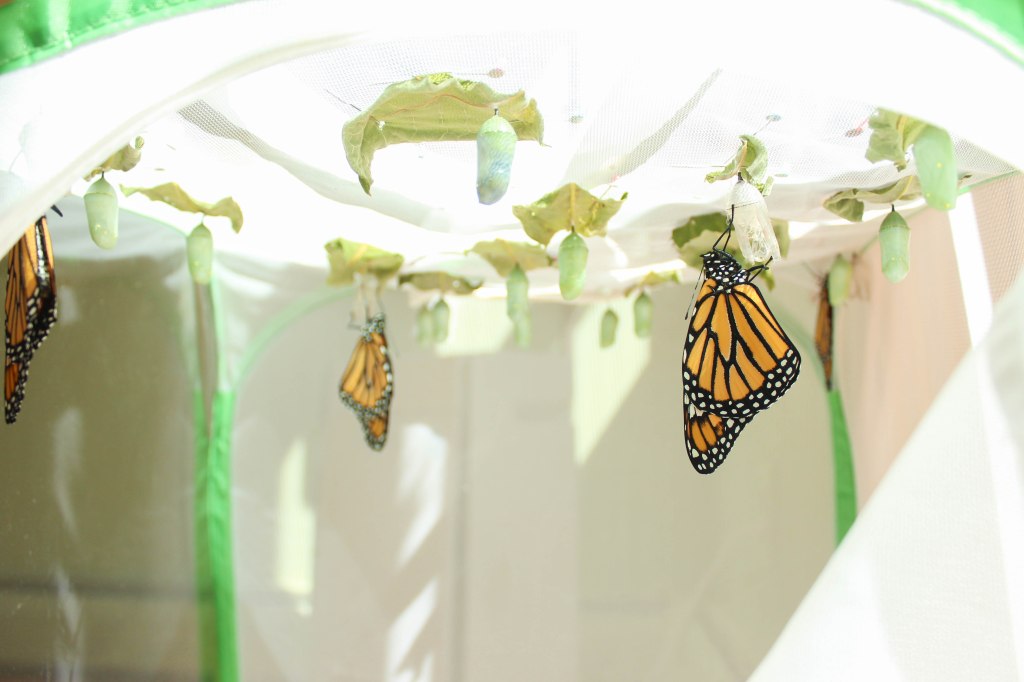
But at the end of the day, as someone who has visibly seen the decrease of monarchs in our area, and as someone who lives in an area abundant in milkweed, greenery, flowers, and space to thrive, I don’t see a problem with me giving these guys a safe place to grow and pupate.
I also don’t see a problem with me letting them enjoy even a couple days of the joy of having their wings in the wild! What a privilege to be able to soar freely in the sky while we humans must just watch them from the ground.
They’re gorgeous pollinators, and they deserve the chance to thrive — with or without my help.
Now that I’ve thrown my two cents into the great monarch debate™, I shall step down from my soapbox and we can move on to the fun stuff (i.e. single-handedly saving the entire monarch population) 🦋
key points for raising monarchs
- Keep their food fresh. Monarch caterpillars eat exclusively milkweed, so you’ll want to always make sure you have plenty of milkweed available. I cut whole milkweed stalks and put them in vases of water; this kept them fresh for as long as needed (which isn’t long when you have a hoard of hungry ‘pillars!)
- Clean the frass (poop) out daily. I spread paper towels on the bottom of the enclosures so that I could just wrap them up and replace them every day. If left to sit, the frass can spread bacterial to the caterpillars, so a clean environment is very important! It’s also another good reason why picking whole stalks of milkweed is great for them. Like in the wild, the frass will fall to the ground, meaning that they rarely come in contact with it.
- Give them plenty of room to grow and thrive. Like I stated before, I do not approve of the jar/tupperware approach. I have multiple enclosures (for different stages of development), this one is my favorite and gives them plenty of space. At the end of the butterfly season you’ll want to thoroughly disinfect the enclosures (do some research on OE in butterflies!)
- Don’t overcrowd the enclosure. Not only does this make it easier for disease to spread, it can also stress the caterpillars out, and if they feel like they need to compete for their food then they can bite or ever eat each other.
- Keep different sized caterpillars separate from each other. For the above reasons — we don’t want any accidental cannibalisms 😬
- Separate the finished chrysalises from the still-growing caterpillars. Having the caterpillars kept with the chrysalises can make it easier for harmful bacteria to spread between them, so I decided to keep most of the chrysalises in one enclosure so that I could keep track of them, and keep them safe from any wandering ‘pillars!
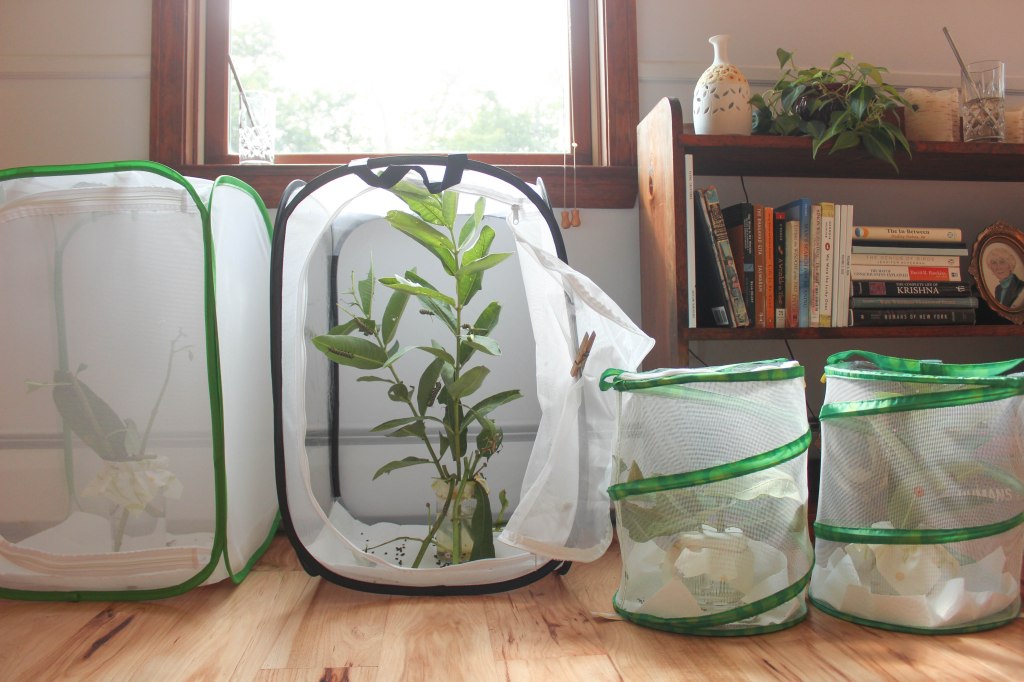
tiny babies started off in the mini enclosures before they were moved to a larger one
how i found them
It had been my goal all spring/summer to find and raise a monarch or two, so I was constantly checking my local milkweed patches, but to no avail. Empty leaves everywhere — not a monarch in sight!
So I was overjoyed at the end of July when I saw an old, weathered lady flitting around my milkweed patch (as mentioned in this post), and knew that she could be doing just one thing.
Sure enough, upon inspecting the bottom sides of the leaves, I was ecstatic to find a whole bunch of perfect lil eggs!
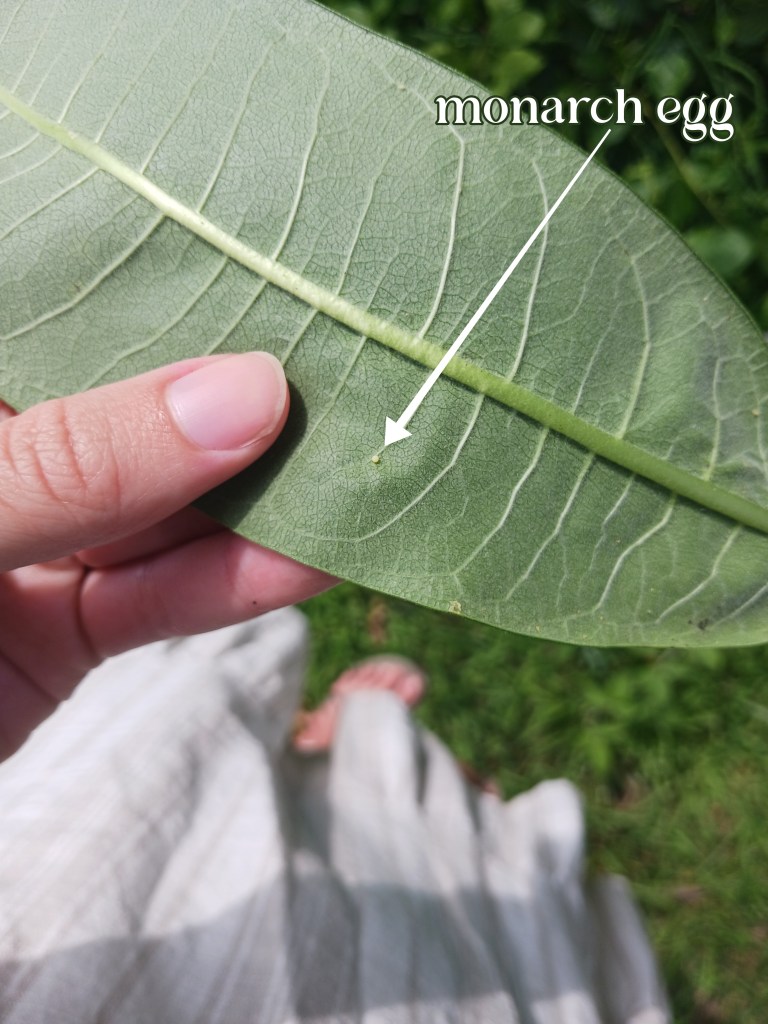
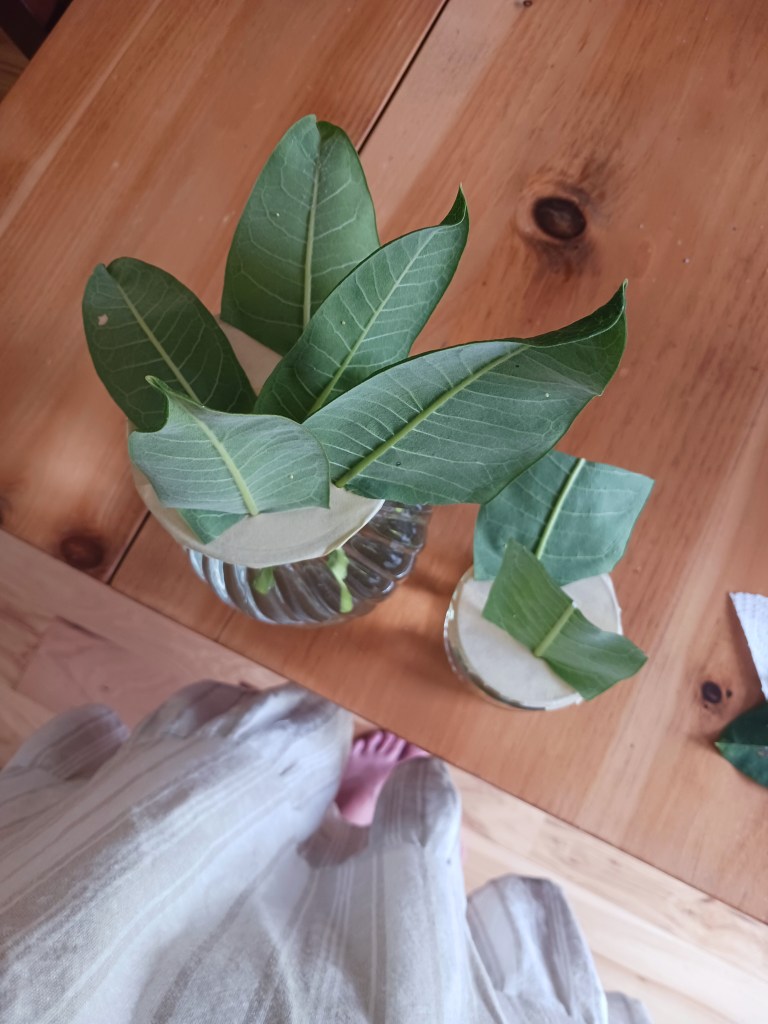
I brought them inside on a bouquet of milkweed leaves, and this is where it all began.
A week or two later I saw a different girl over in the milkweed patch and collected some more eggs. While on a walk I stumbled upon some newborns on a leaf and took them home with me, and my friend gave me any ‘pillars he found down at the farm.
I had a whole collection of different gene pools, and all of them grew without any problems!
the eggs
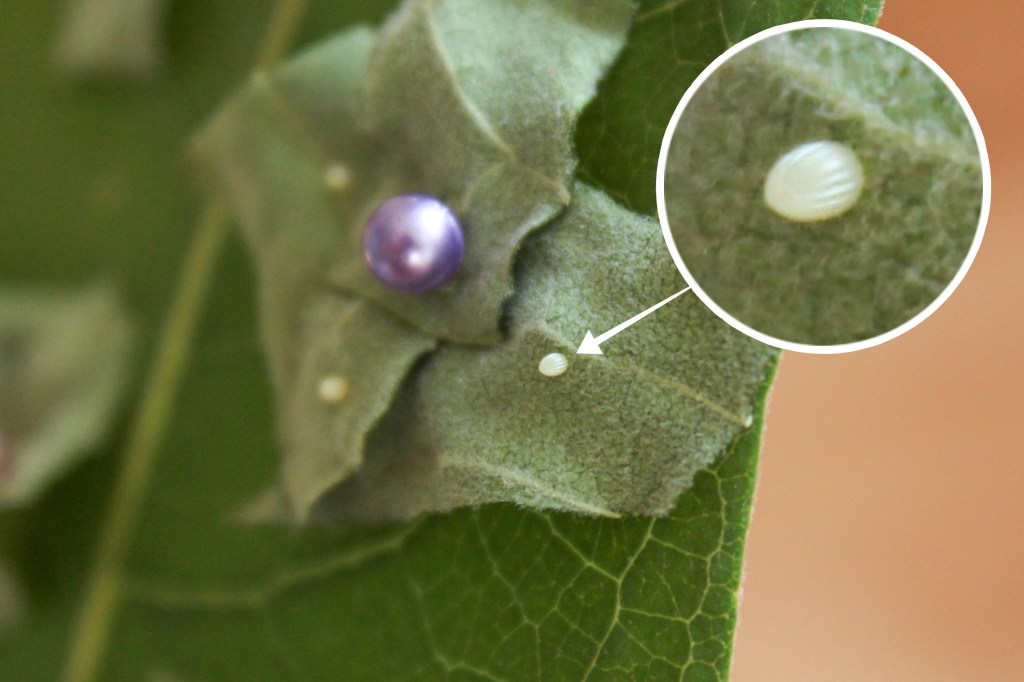
freshly laid eggs; an easy way to transport them inside is to cut the piece of the leaf they’re on, and pin it to a leaf that you have ready for them inside
The eggs are tiny, oblong, cream dots with little vertical ridges around them — and they shimmer a little bit when you look at them in the sunlight! They take 3-5 days to hatch, and you know when they’re about to hatch because you’ll see the dark head of the caterpillar at the pointed top of the egg. I noticed that they generally hatched within 24 hours after seeing the head appear.
The caterpillars are unbelievably tiny when they emerge, and the first thing they do is eat their egg.
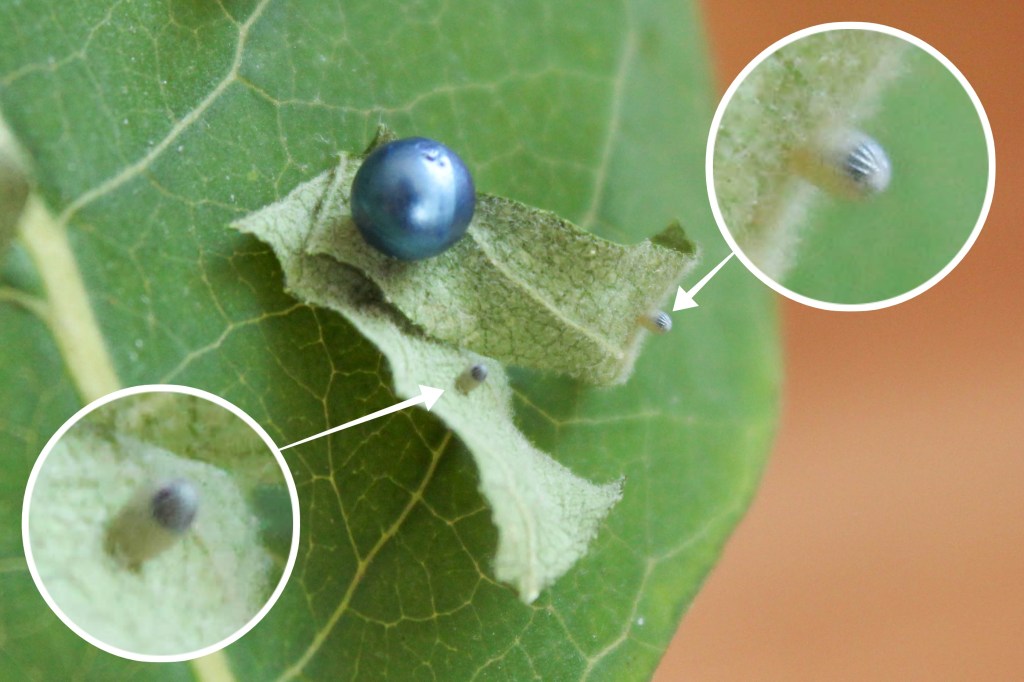
eggs that look like this will generally hatch within the next 24 hours
You can notice significant growth every single day after their birth, and within the first 24-48 hours they’re already starting to develop their stripes.
They’re hard to keep track of at this point, and should just be left alone. If they needed to be moved to a new plant then I cut the piece of leaf that they were on and pinned it to the new leaf that I wanted them on. This was my moving method for all the babies of any size and it worked out great!
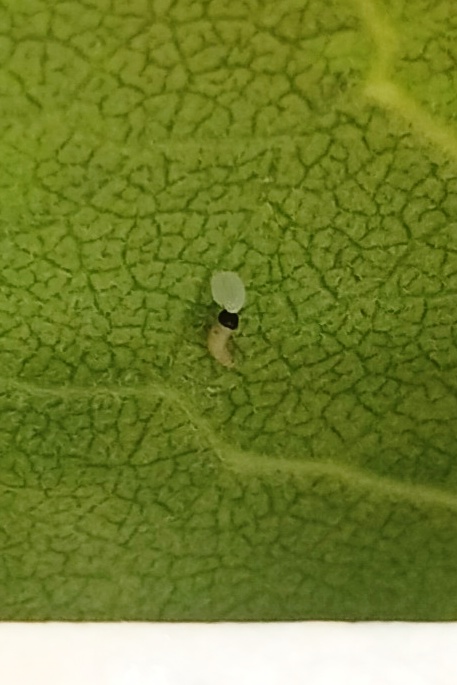
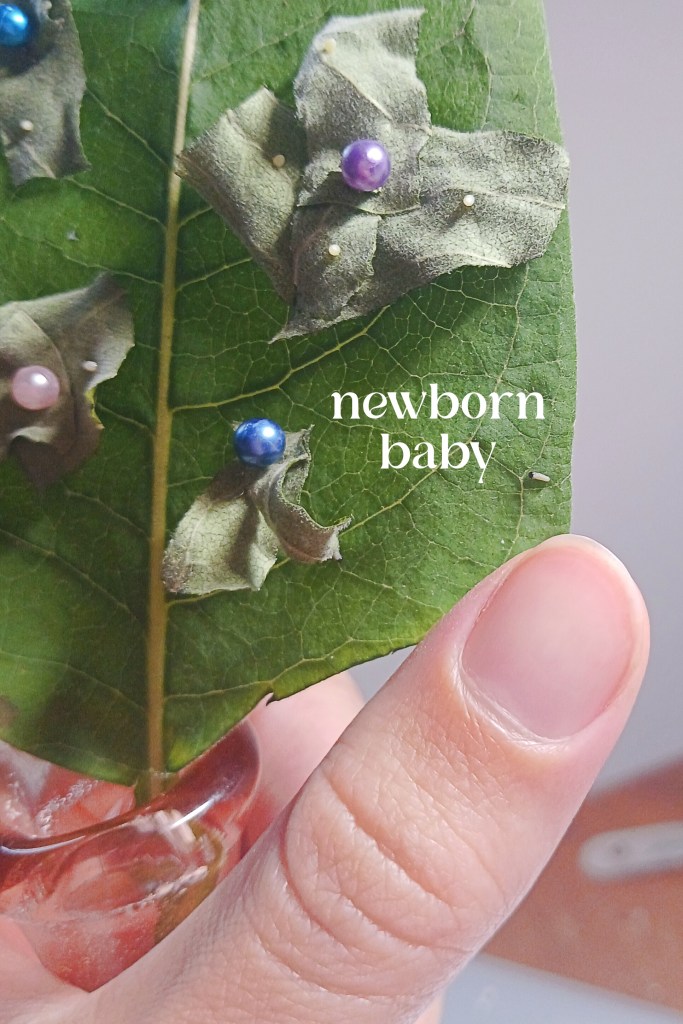
the little baby on the left is fresh out of the egg is starting to eat it — they just look like little grubs at this point
the growing stage
Like I mentioned before, I found it was best to pick whole milkweed stalks for these guys, not only because it mimics their natural environment, but also because it provides them with room to explore, and plenty of leaves to choose from to eat and pupate on.
The caterpillars choose to stay on their milkweed stalks the entire time they’re growing; the only time they started to venture off of them was when they were ready to pupate. And even then, most of mine just decided to pupate on the underside of a leaf of their choosing!
The caterpillars typically take 10-14 days to grow into their full thicc selves, and should end up being around 2″ in length. They have a total of five instars (instars are the stages between molts), and one thing that’s important to note is that when one is getting ready to molt: they’ll stay stationary, not moving or eating, for a good chunk of time.
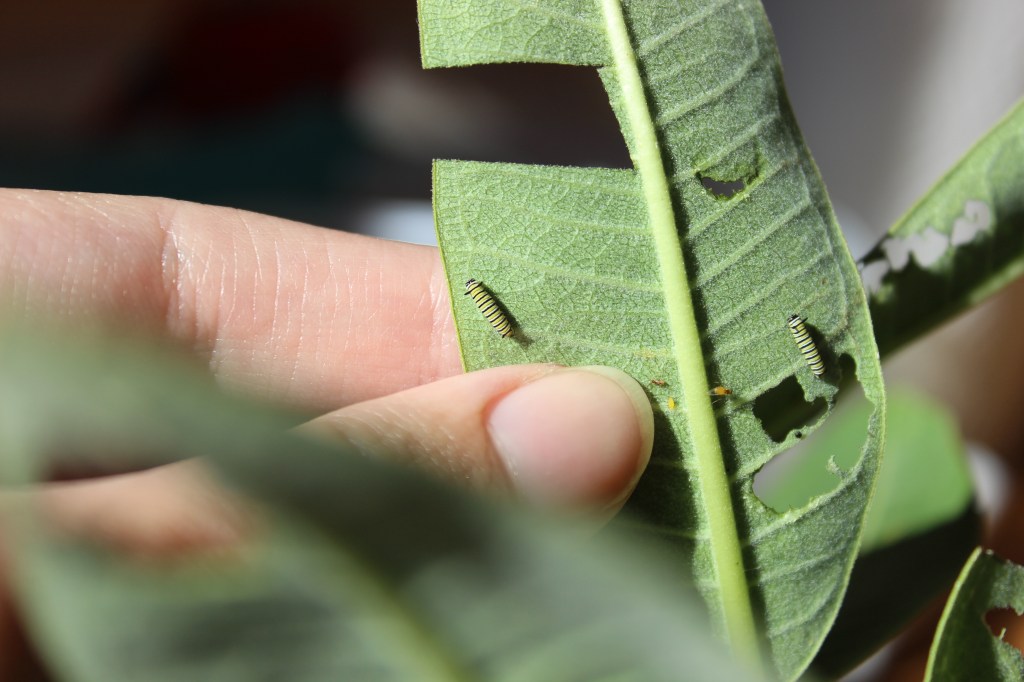
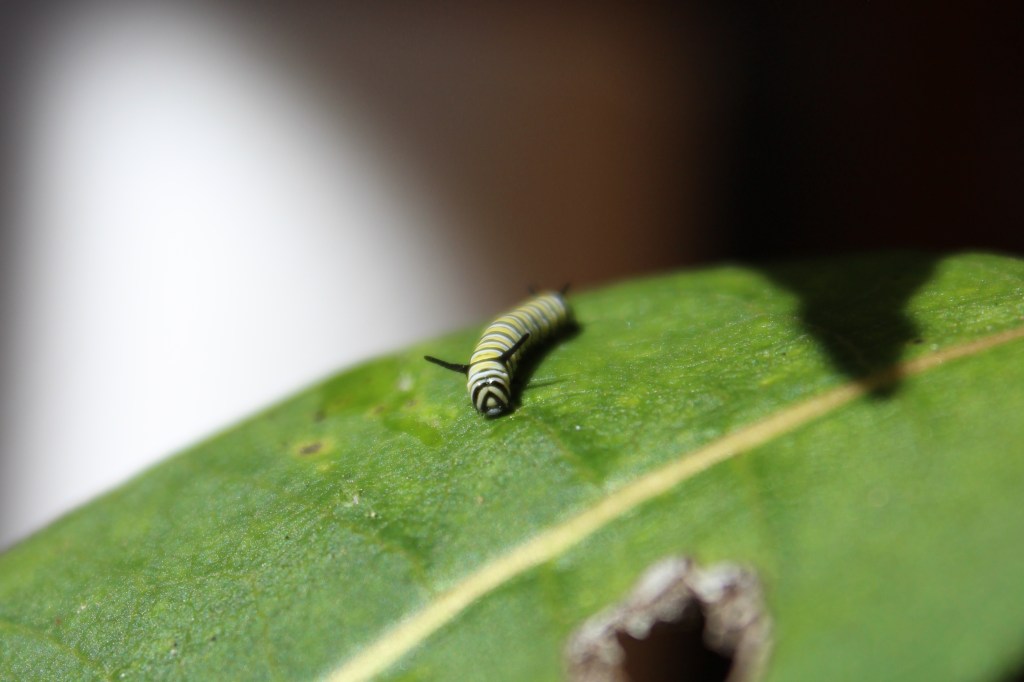
some young lads who’ve just started to grow into their stripes
If you see a caterpillar has been sitting in the same place for hours on end, it looks healthy, but it’s not eating? It’s probably getting ready to molt!
I started being able to see the signs of a coming molt by looking at their heads. When they’re getting close to a molt then their heads seem to kind of shrink in comparison to their body; that’s because the “head” that I was seeing was pretty much just a head “cap” that was about to be molted off to show the new-and-improved head underneath!
After they’ve molted they’ll typically eat the skin that they shed, and then wait patiently while their new head and limbs harden again.
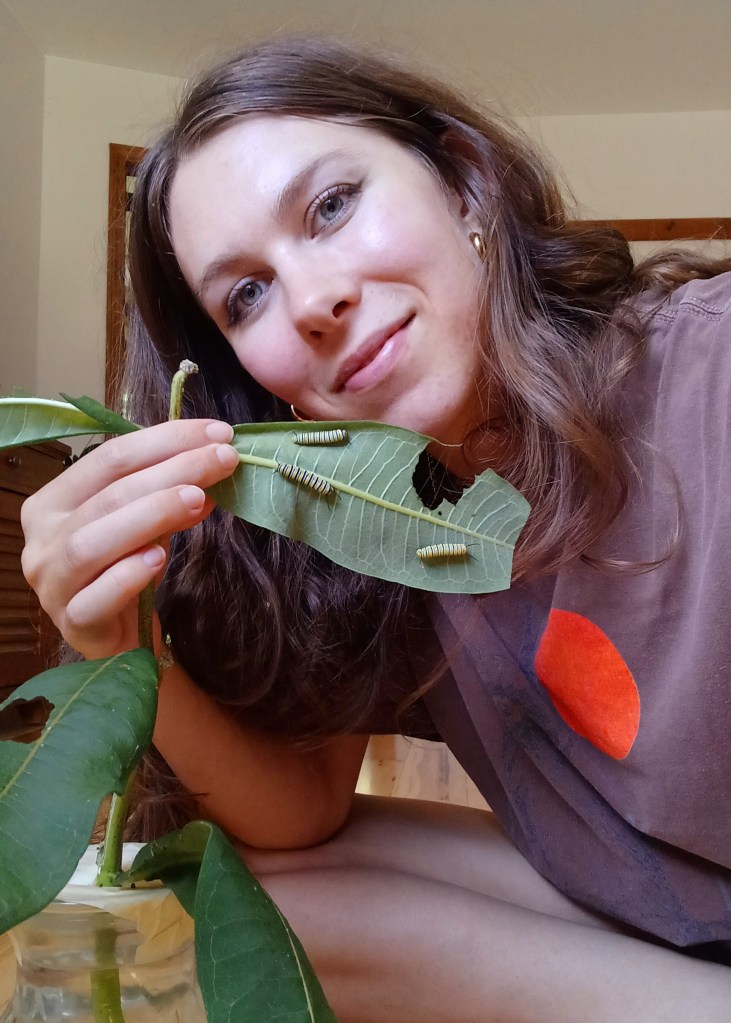

Monarch caterpillars have two pairs of antennae-like appendages; one near their heads, and the other near their bottoms. Although they look like antennae, they’re actually not; they’re sensory organs referred to as “tentacles.” They headbang with them when they’re upset, which is just adorable.
Aside from molting, during the growing stage pretty much all they do is eat, sleep, and poop (excessively, hence the daily cleaning). And if you watch them, you’ll notice that they stretch when they wake up, which is freaking adorable 🥺
Out of 37 small lads, I only had 2 deaths. One was very early on (all my caterpillars were still quite small), and it looked like he had gotten bit by another ‘pillar. I only learned later on that caterpillars can bite each other, and, if the environment is right, even cannibalize each other. I didn’t have a problem with this (the cannibalization) since I kept the caterpillars clean, gave them enough space, and provided them with ample food…but after this incident, I was much more careful to keep different sized caterpillars in separate enclosures. Sizeism can actually be very important in this situation ☝🏼🤓
The second loss I had was just that: a loss. This caterpillar was only a couple days old and he was on a plant with one other ‘pillar of similar size. One minute he was there, the next he was gone. Did he fall off? Get eaten by his brethren? We may never know. We searched high and low for this little guy, but never saw a trace of him. Unfortunately the only flying he’s doing is with the angels now ✌🏼😔
getting ready to pupate
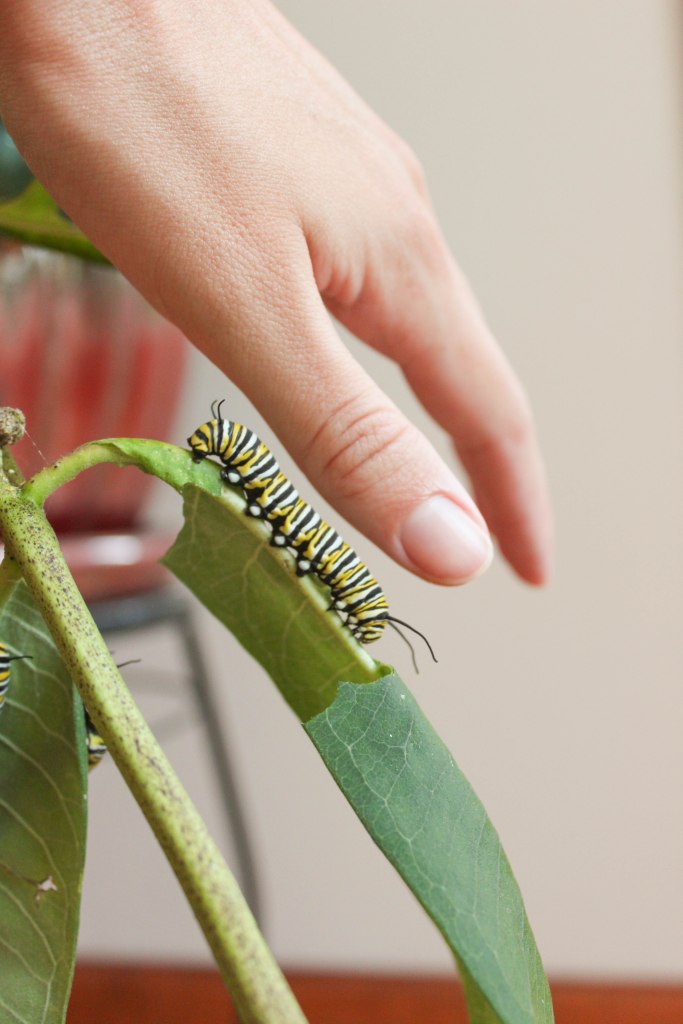
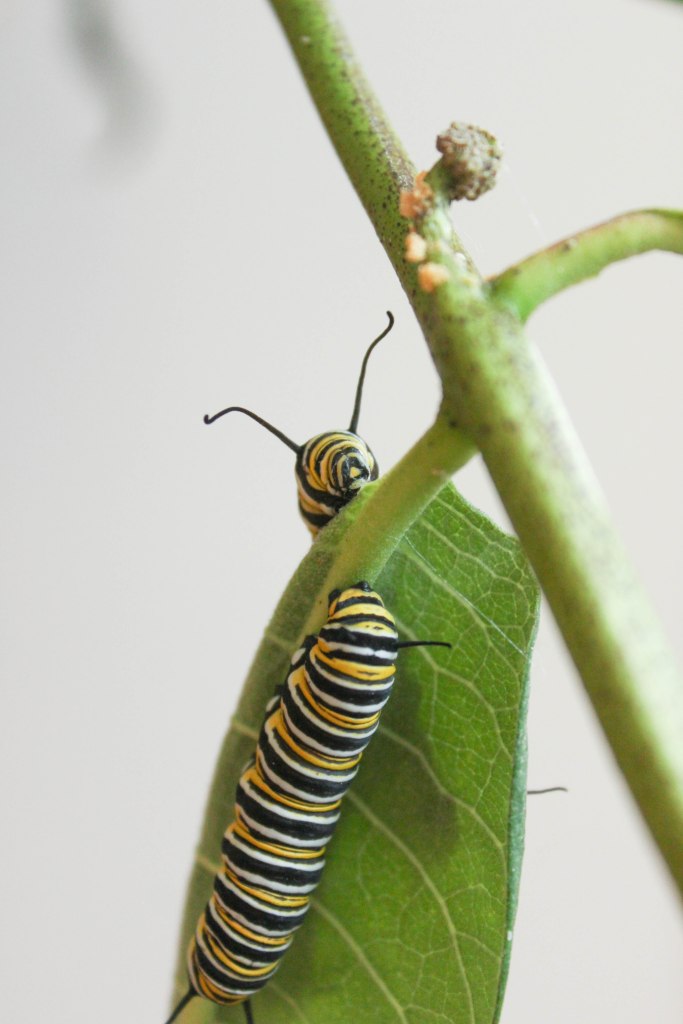
my thicc lil dudes
Once the caterpillars reached maturity, they suddenly got super antsy and started crawling around, looking for the perfect spot to start the next stage of development.
You’ll know when this is happening, because it’s basically the only time that they stop showing interest in food, and start showing interest in exploring their enclosure. While some will tend to gravitate toward the top of the enclosure, I had most of mine just choose a good, healthy leaf to pupate on.
They first start by creating a silk anchor in the spot of their choosing. They make this anchor with their mouth, before they turn around and attach their little bottoms to that spot of silk.
The next step is forming their “J” shape, which is exactly what it sounds like. They hang upside-down in a “J” shape, preparing to turn into their chrysalises. Usually within 24 hours of seeing that “J” shape appear, the caterpillars will have morphed into their gorgeous green-and-gold chrysalises!
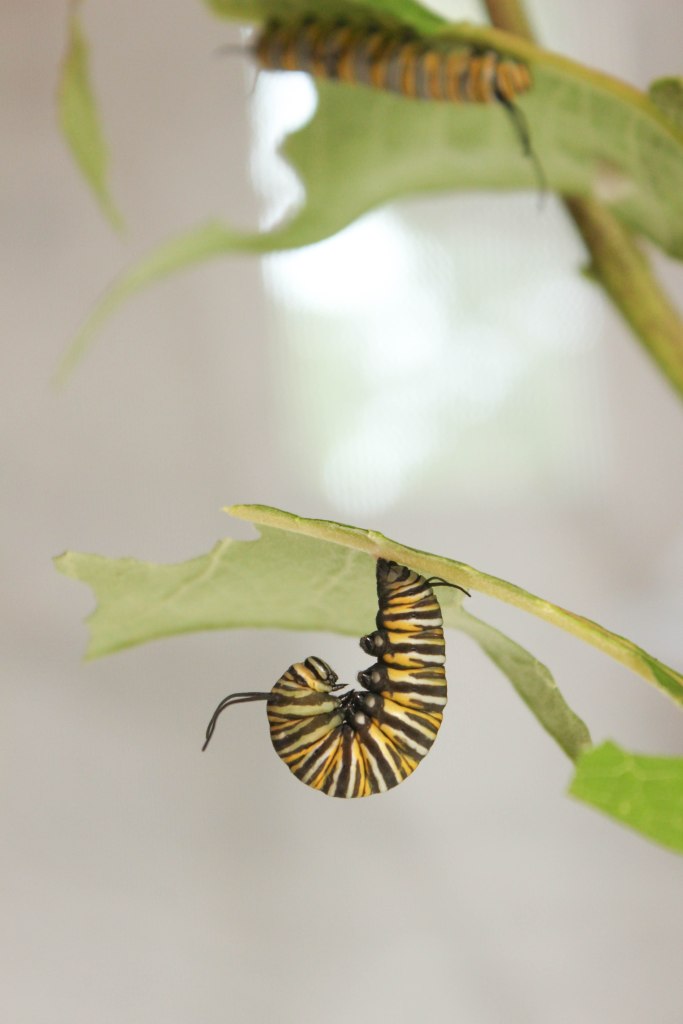
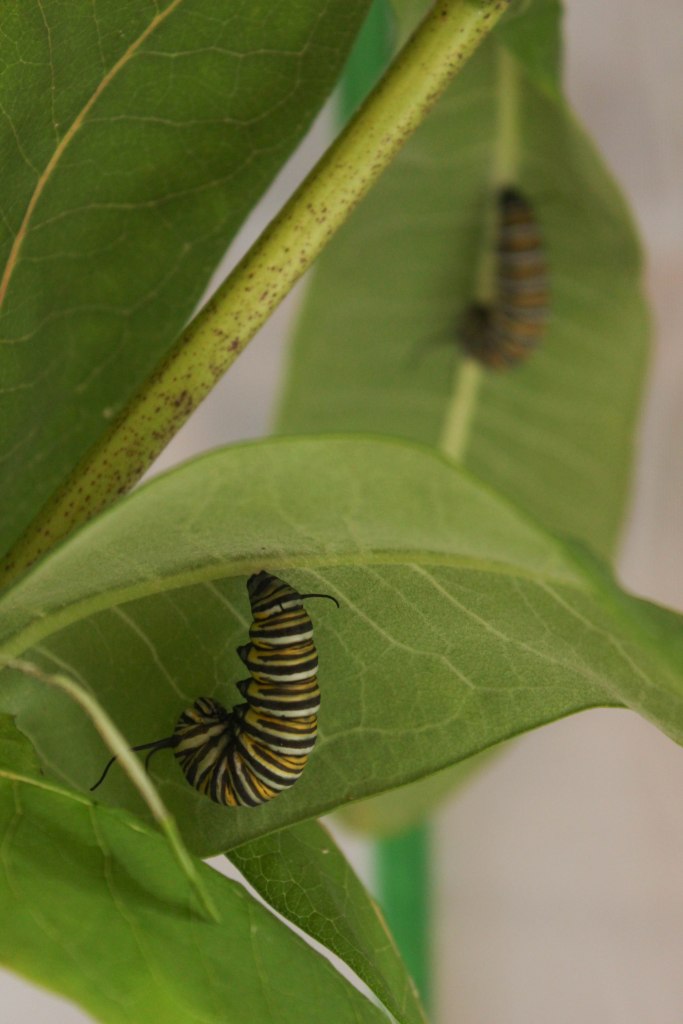
if you look closely, you can see that the caterpillar on the left is already getting a green hue to him near his head — this is because he’s already starting to turn into a chrysalis under his skin!
pupating
I was lucky enough to catch the show live one time — after sitting and waiting patiently for it to happen for close to two hours (my neck was not happy), and it was nothing short of insane. My brain still can’t quite comprehend what happened.
You can see the sped-up version of the video in one of my YouTube shorts!
For a couple of hours before the magic happens you’ll be able to see what looks like the caterpillar having contractions. Apparently this is the caterpillar changing into the chrysalis right under its skin. The tentacles deflate and shrivel up (looking like little party streamers!), the skin gets thin and dull, and you can see a tinge of green under it.

watch the insane process here!
When the caterpillar is done with its initial work, it’s simply a chrysalis wearing a caterpillar costume.
It then splits near the back of the head and shimmies its way out of the dead skin, wiggling like crazy at the top to drop the skin and securely attach its little stem to the silk anchor.
After this, it just completes the process by contracting, hardening, and developing those classic shimmery gold details.

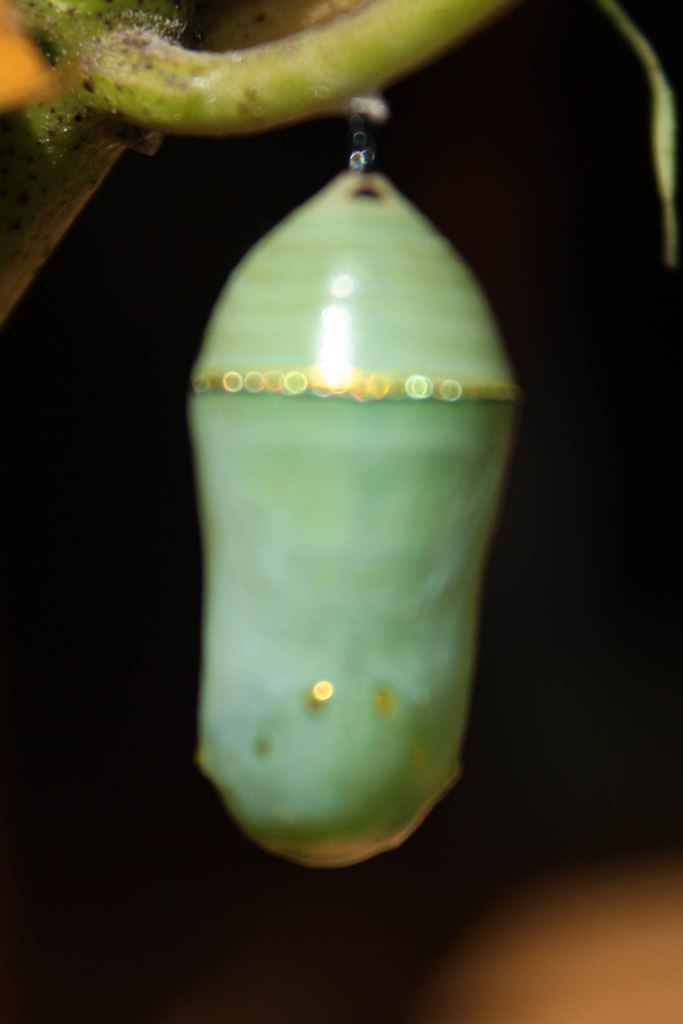
the photos don’t even begin to do the coloring and details justice ✨
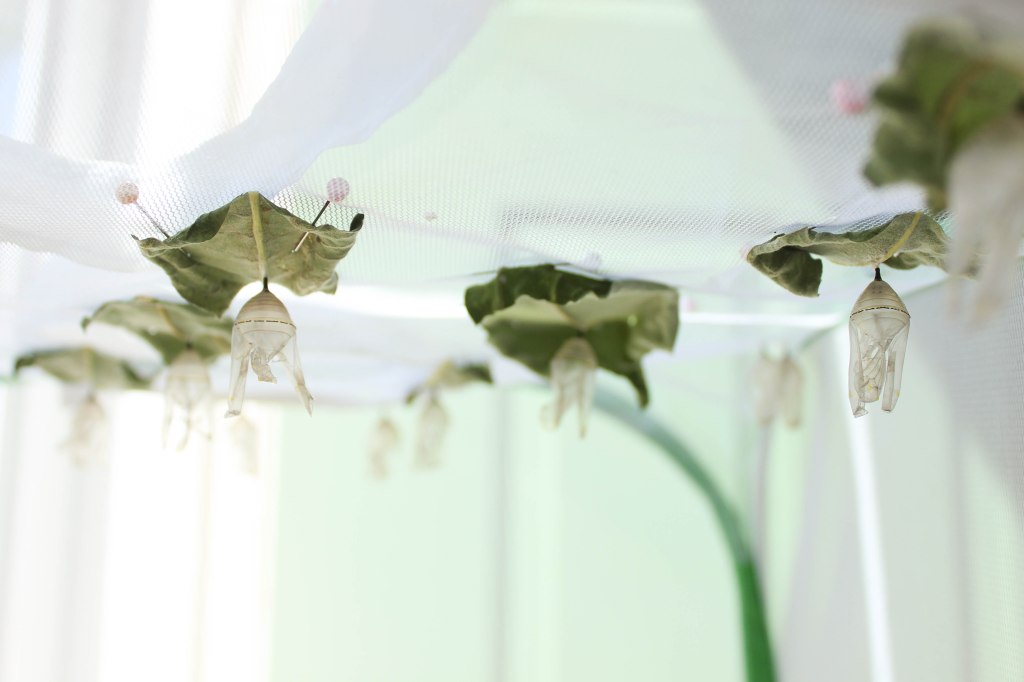
I moved most of the chrysalises into one enclosure, to keep them away from the still-active caterpillars and their frass, and the sea of ever-growing chrysalises, with their shimmery gold accents, looked absolutely magical.
Monarchs typically stay in the chrysalises for 10-14 days, although some have been known to hatch in as little as 8, or take 2+ weeks! Most of mine started popping at the 12-day mark.
Any time I saw a chrysalis that I wanted to keep an eye on, I moved it into a separate enclosure (one had a discolored spot that seemed to be superficial, another was abnormally small), but all of them ended up hatching perfectly, and all my monarchs appeared robust and healthy (even the tiny girl!).
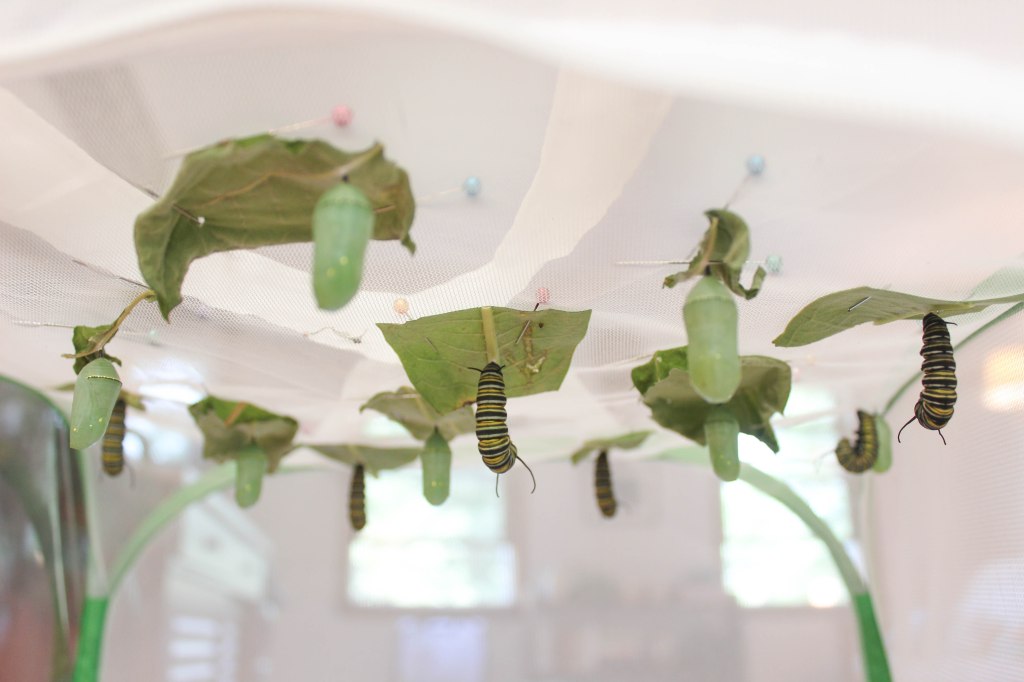
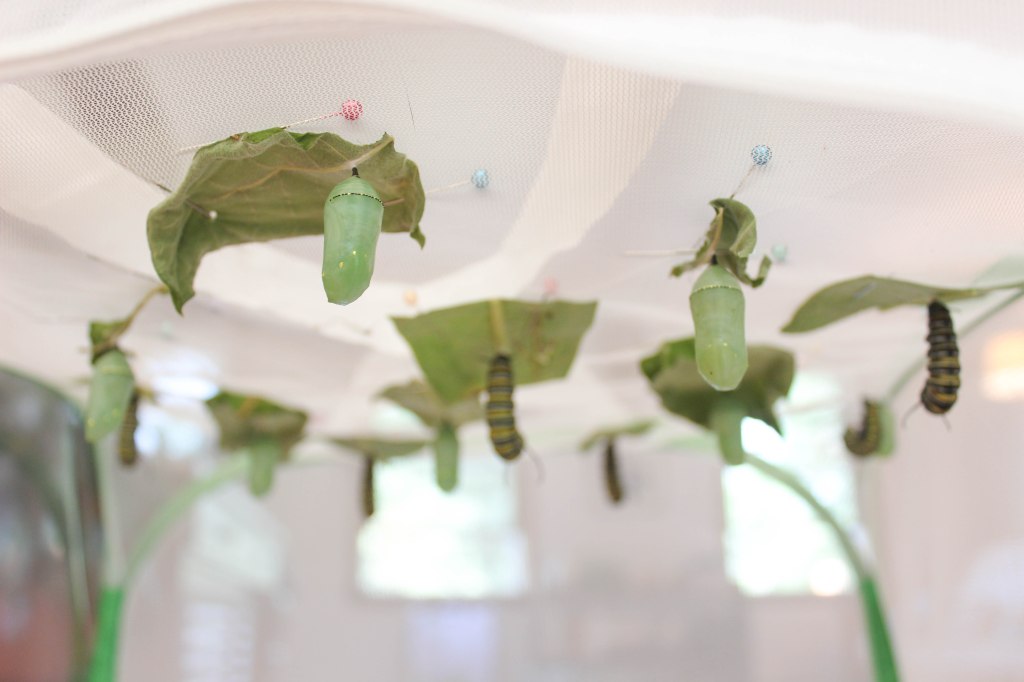
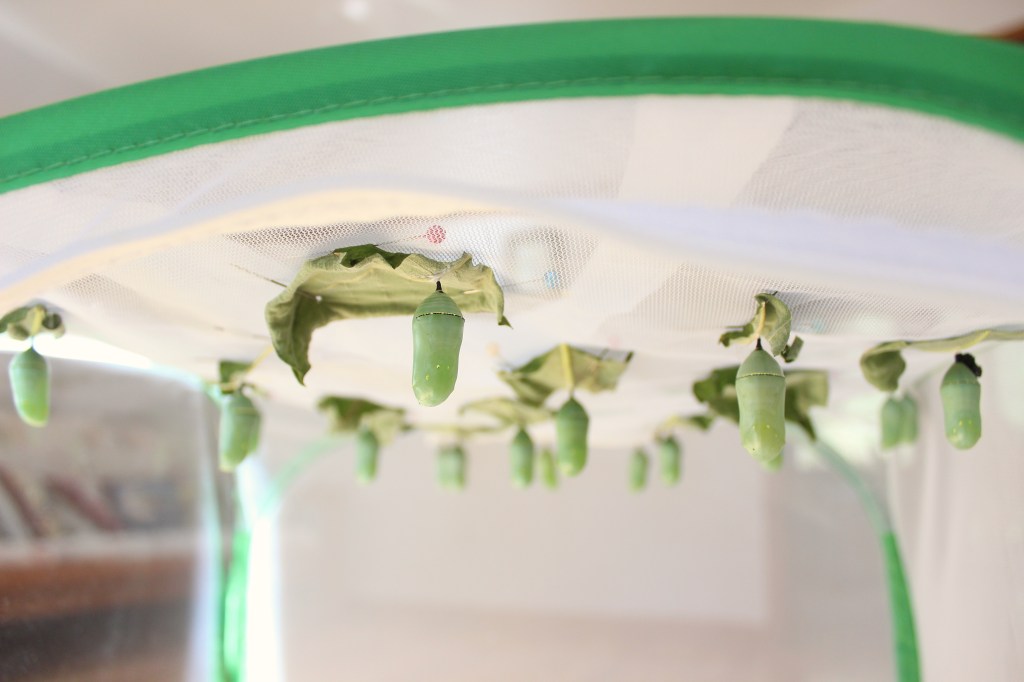
I started moving some caterpillars over during their “J stage”, because other caterpillars started eating the leaves that they were on! Moving them carefully and pinning them to the top of the enclosure did not interfere with their process, and they all pupated without any problems
As the butterflies start to develop in their chrysalises, you can start to see different parts appearing through the chrysalis wall. According to Monarch Joint Venture, this is not because the chrysalis is suddenly turning transparent, it’s because the scale pigmentation is one of the last things to develop! So basically you’re just quite literally watchin’ the butterfly develop through its chrysalis.
This fact blew my mind.
You’ll start to see the black coloring of the legs appearing (tucked up in the front of the chrysalis in an upside-down “V” shape), as well as the lines of the wings — first with no color at all, and then turning vibrant orange when it’s ready to hatch.
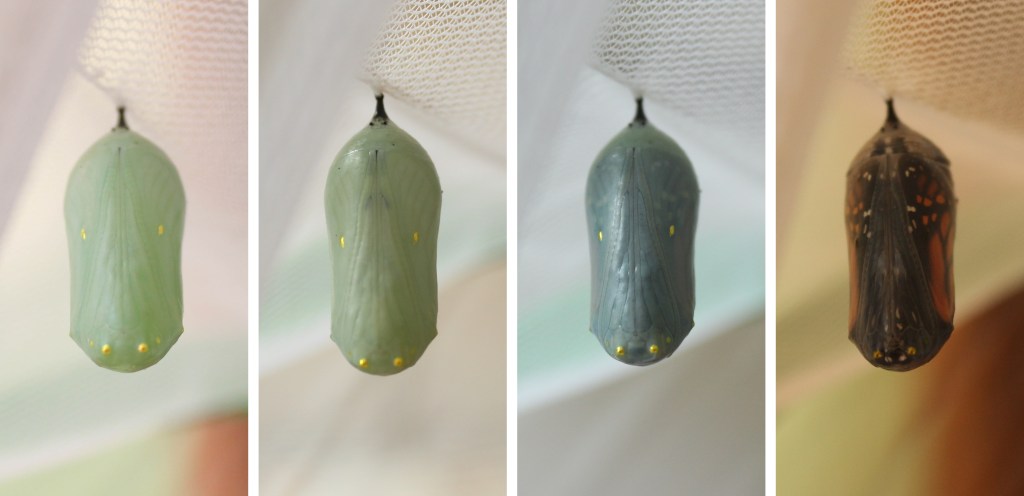
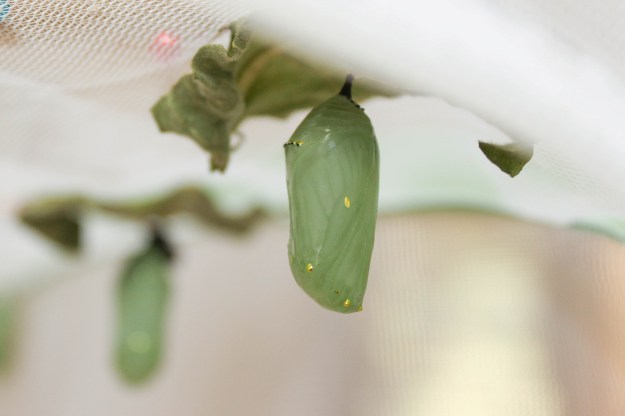
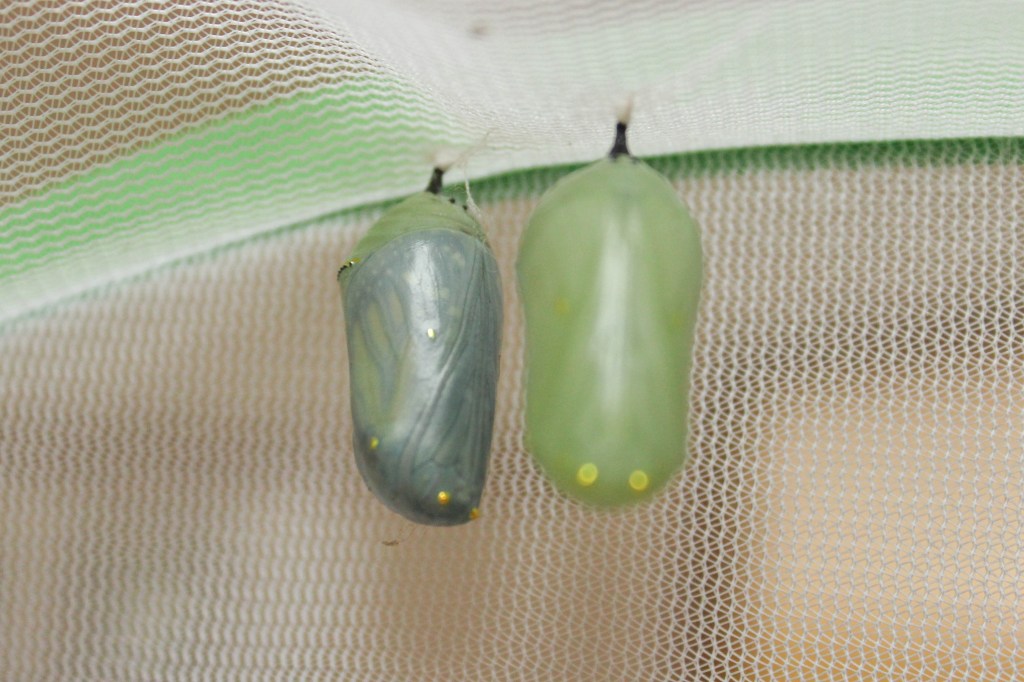
you can see the lines of the wings appearing (bottom left), before they start to get their pigmentation (bottom right)
hatching
Every single one of my butterflies hatched in the morning, and the morning of the hatch-day the chrysalis was fully black with the orange wings on full display. The butterfly then began to detach from the inside of the chrysalis and at this point you can see that the top of the chrysalis takes on an “accordion effect.”
If you wanna witness the hatching process, this is when you want to start watching!
I was lucky enough to catch multiple butterflies hatching, and got to watch the whole process in real time.

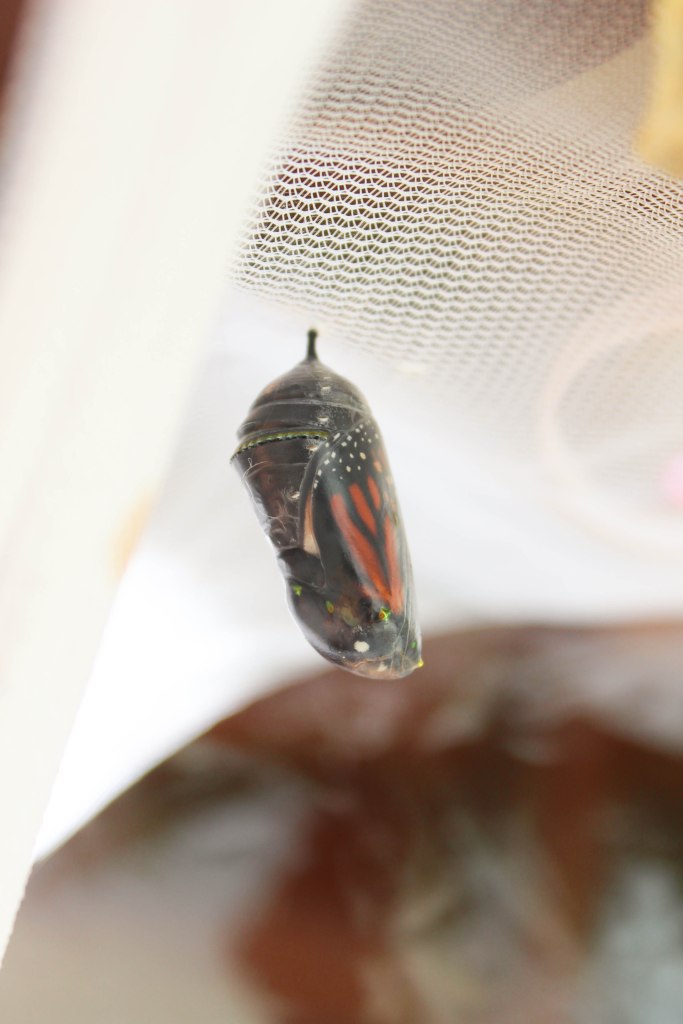
both of these photos were taken the morning that they hatched; on the left you can see the totally black chrysalis, and on the right you can see the accordion effect happening at the top of the chrysalis
When the chrysalis splits it makes an audible crinkling sound, which is oftentimes what let me know it was time! After that first split, the butterfly emerges so insanely quick, you can easily miss it if you walk away even for a moment.
The wings appear tiny and shrunken (they remind me of little Shrinky Dinks), and the abdomen first pops out short and thicc. If you watch it, you can see it pulsating while it pushes fluid into their wings to expand them.

if we’re being real…butterflies basically give birth to themselves
All of my butterflies clung onto their chrysalises for this entire process — hanging upside-down is absolutely crucial at this stage of development! They also do this swaying dance right after they hatch, which I first thought was just them getting their footing, but I soon realized it was beings done intentionally. I’m assuming to get all that fluid pumping. It was adorable 🥺
The butterflies all remained in the same spot for 3-4 hours after hatching, while their wings dried and hardened. You’ll also notice that they’ll start dripping excess liquid after their wings are fully unfurled. It will start out a reddish/brown color, and then turn clear.
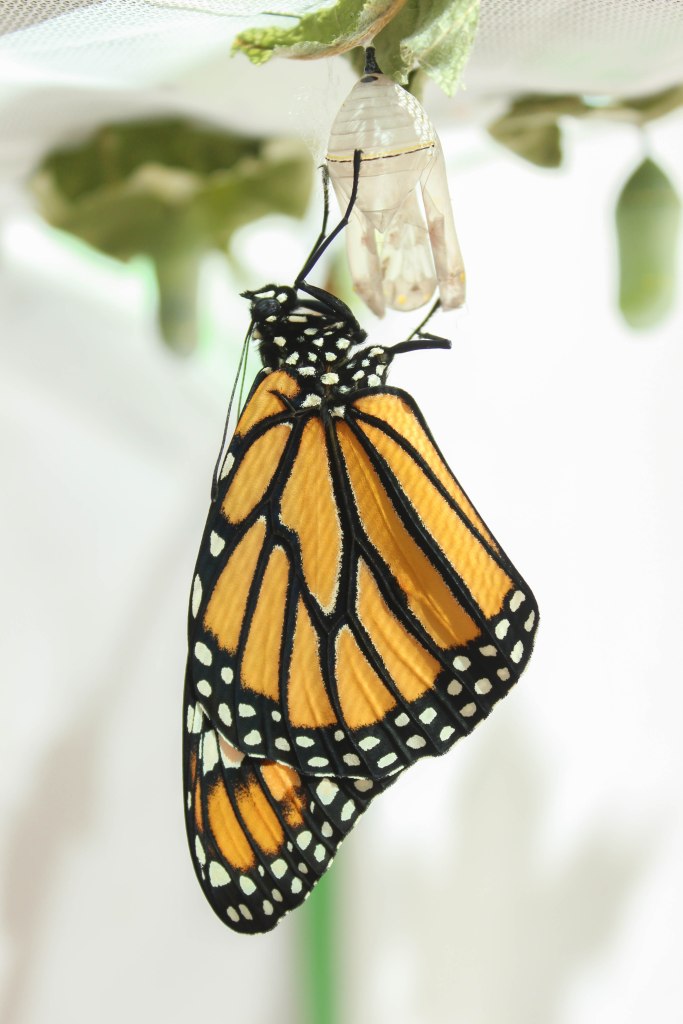
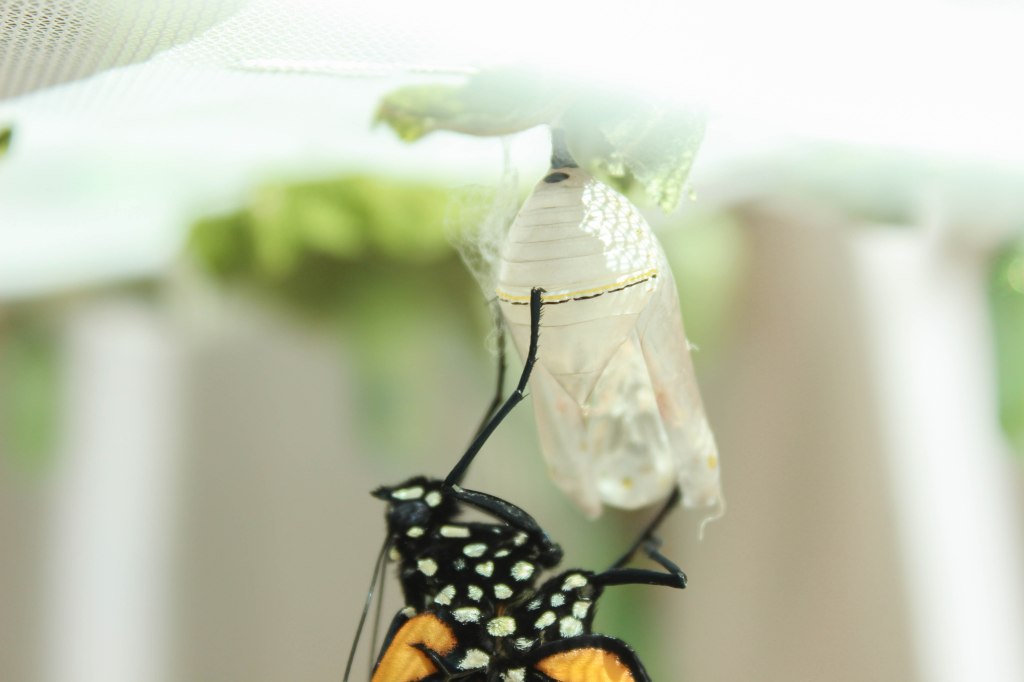
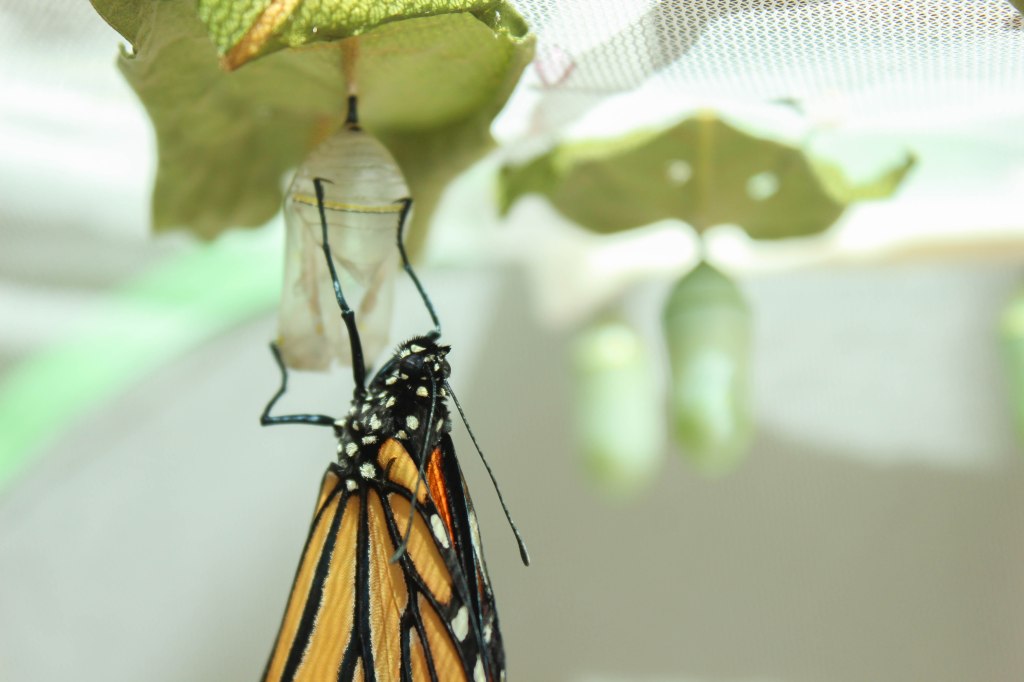
you can kinda see in the bottom right photo that their legs are actually iridescent and shimmer blue in the sunshine! It also appears that they only have four legs, because their other two are small and tucked up against the front of their body. Why? I have no idea.
releasing
Once they started to flap their wings, flutter around, and get antsy, I would bring them outside to sit in the sun and see if they were ready to fly away, but I learned after a few butterflies that it was often best to wait until the next day to release them.
They don’t need to eat during the first 24 hours, and holding onto them for those extra hours also gives them important time to mature all their systems — including their sight!
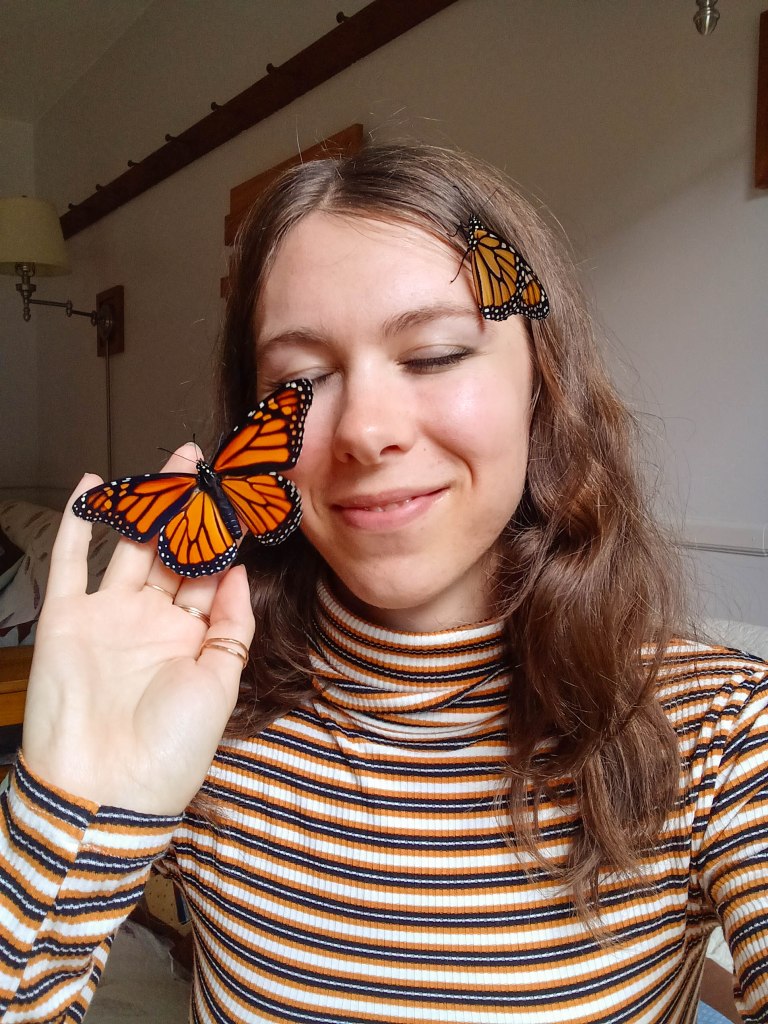

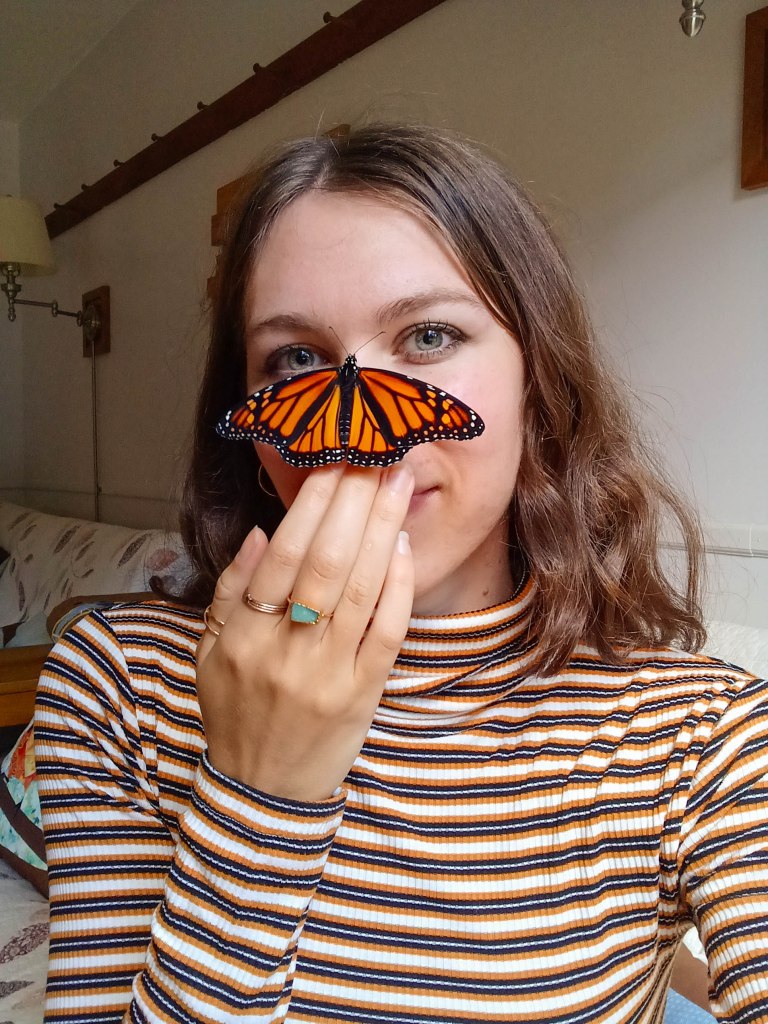
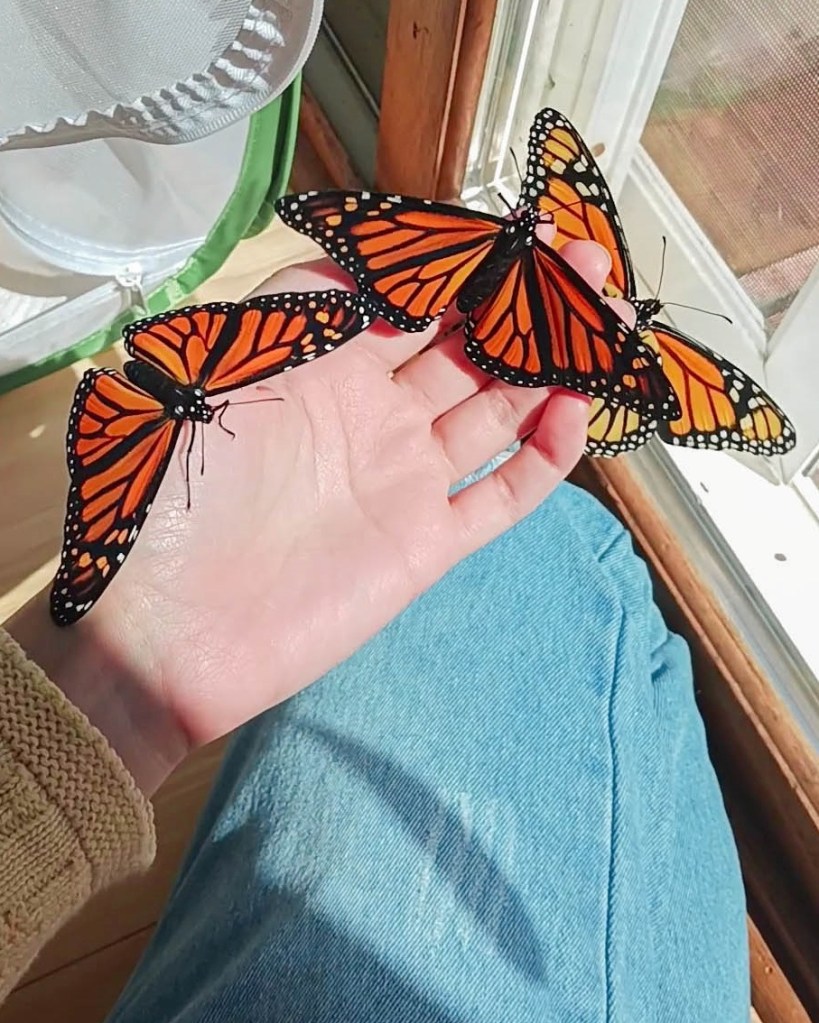
hangin’ out with some beautiful girls 🥰
There were definitely exceptions though, and plenty of my butterflies wanted to be released sooner than this.
If you just watch and interact with your butterflies then you’ll know when they’re ready to leave! While some were clumsy and unwilling to fly off until the next day, others were incredible flyers and instantly left my hand in the afternoon of their hatch-day.
Every one was different, and each successful release was super special.
This should go without saying, but make sure to always release your butterflies somewhere where plenty of flowers and milkweed are readily available! It’d be pointless to raise them to adulthood just to have them starve in the wild!
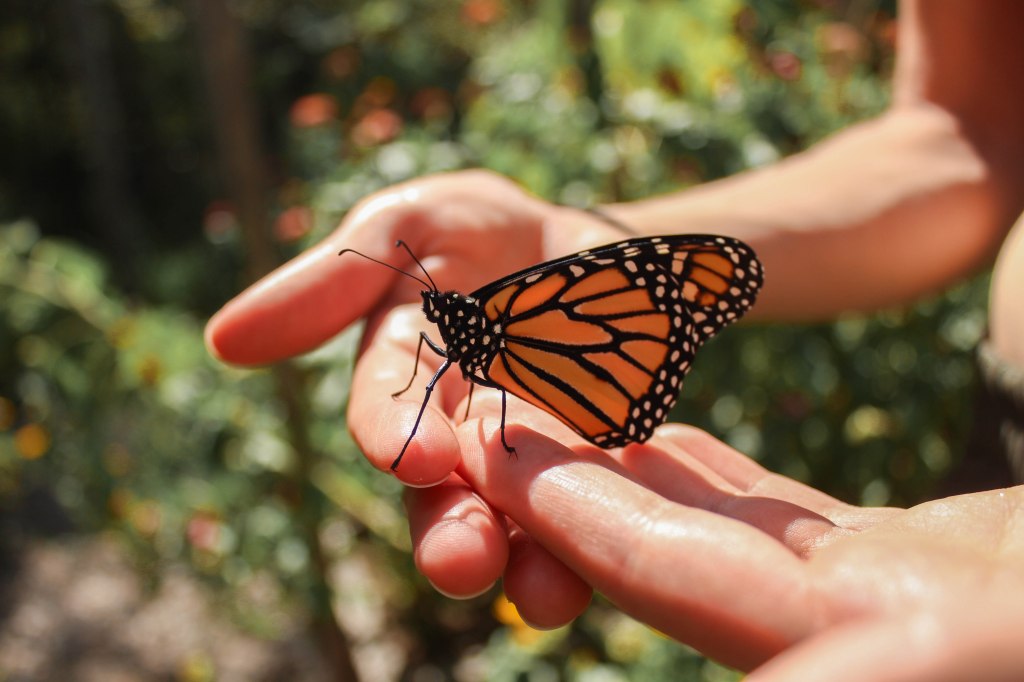
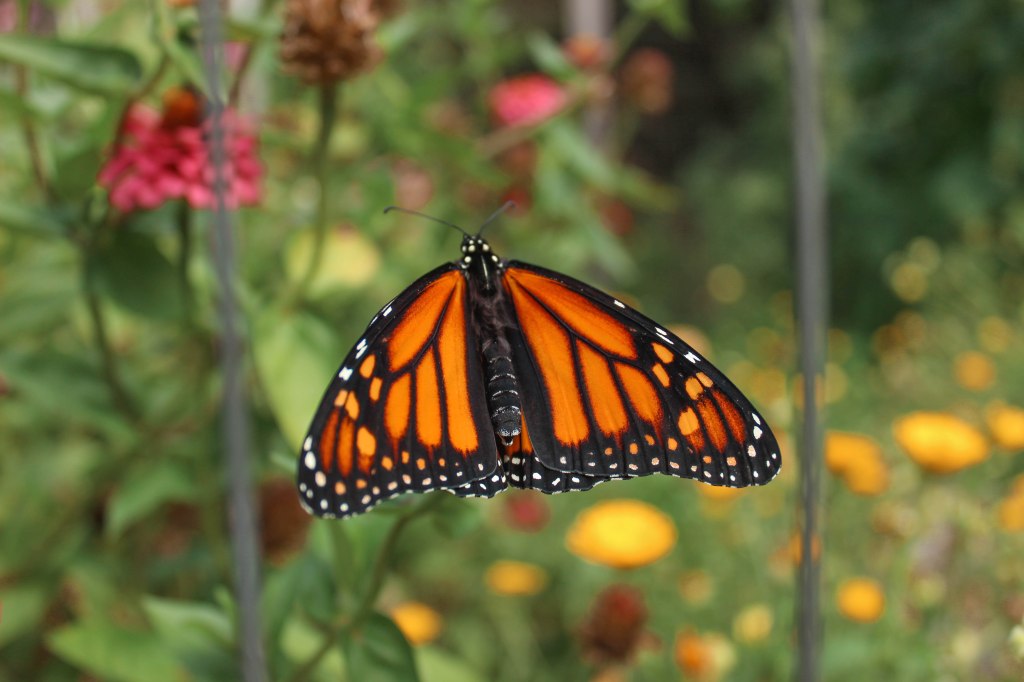
I had plenty of flowers to offer them in my garden (their mother was often flitting among my zinnias), but sadly they all went on their merry way and I really haven’t seen too many of them back here
closing thoughts
I have to say, it was so much fun to get to interact with my little guys. I didn’t have a fear of these caterpillars and butterflies, but there’s always been a healthy caution while interacting with delicate insects.
Being able to interact with and handle these stunners made me so much more comfortable with them; they’re actually hardier and stronger than you’d think. You can feel the little spikes on the butterflies’ tiny feet gripping your hands, and the soft wings when they brush against you. They’re incredibly beautiful in real life, and so much bigger than I thought they were.
I also love that you can tell the genders apart, so I was able to keep track of who I hatched. My tally ended up being 22 females and 13 male, for a grand total of 35 successful releases ❤
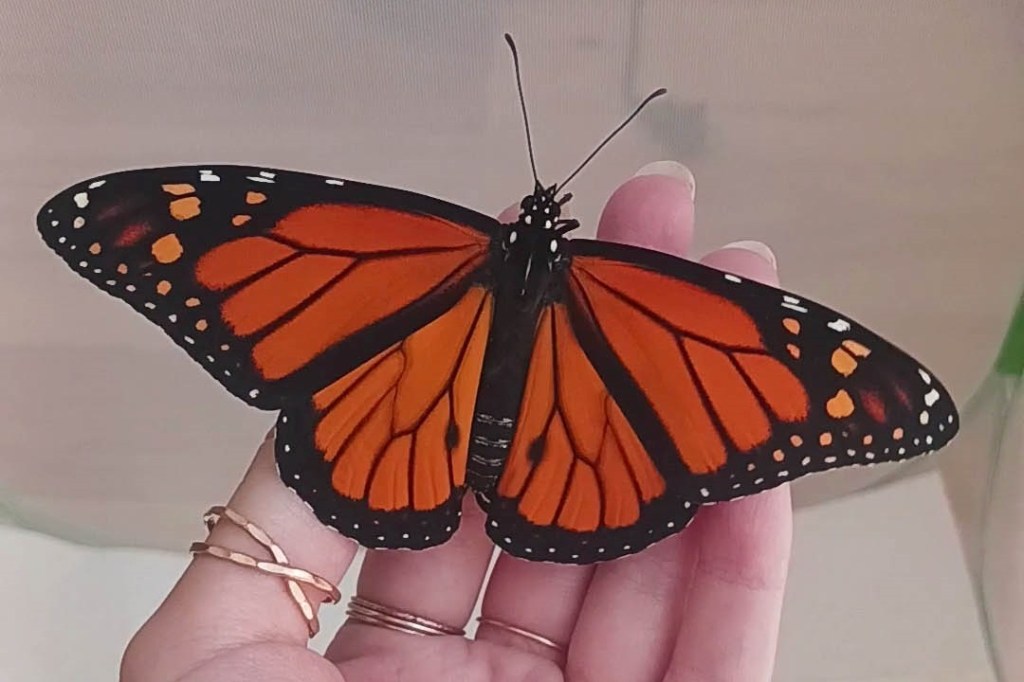

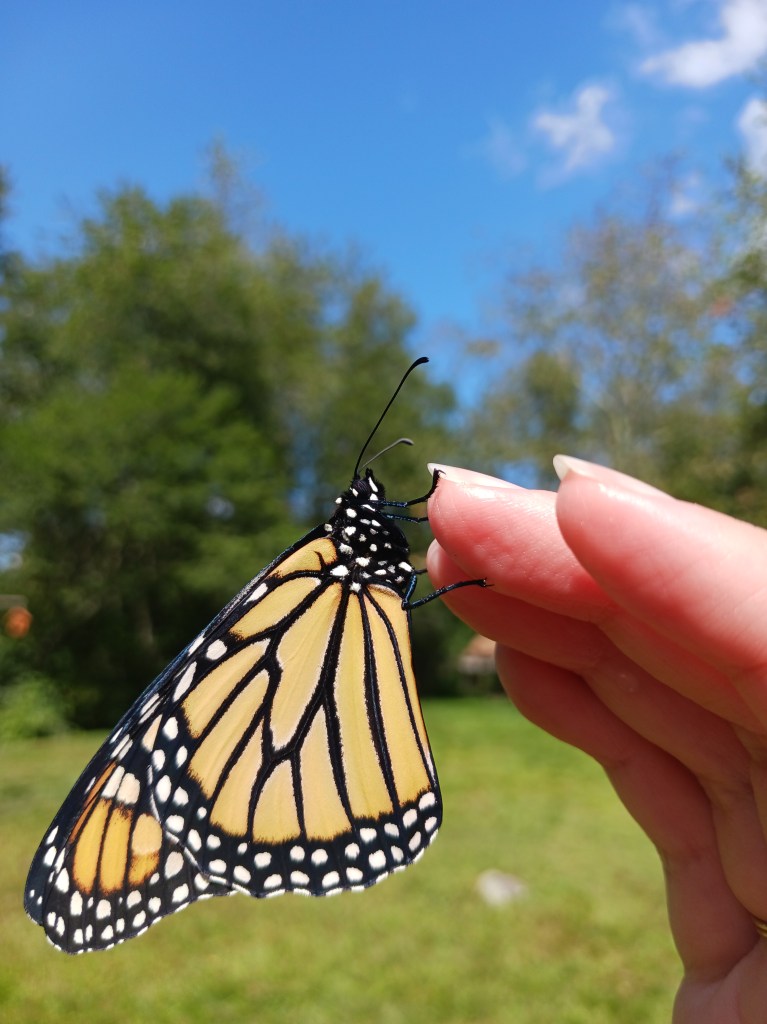
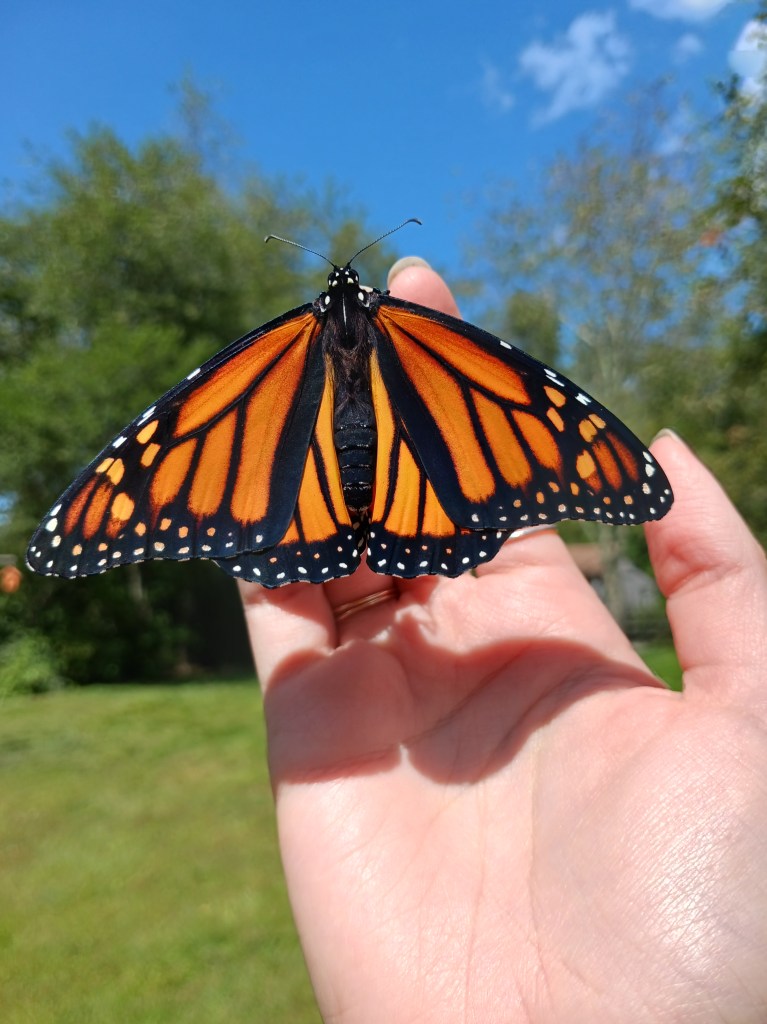
the male (bottom left) has thinner lines on the wings and a black scent gland on the bottom two wings; the female (bottom right) has bolder wing lines and no scent gland
All in all, this was a highly successful first year of raising monarchs, and they were so much easier to care for than the Eastern Black Swallowtails were!
After the initial two losses (both super early on), it was a 100% success rate, and I’m so grateful that I got to give these guys a chance at life! I just love them so much, and they brought me so much happiness with their fuzzy little spotted bodies and their alien-like heads looking around at the big wide world…it’s just too much 🥺
Hopefully some of them have continued to survive and thrive, and are making their way down south for the winter. Perhaps next year I’ll be raising these guys’ offspring.
Onward and upward, my good fellows…onward and upward 🤧❤
my YouTube shorts
 art by jordan rae