
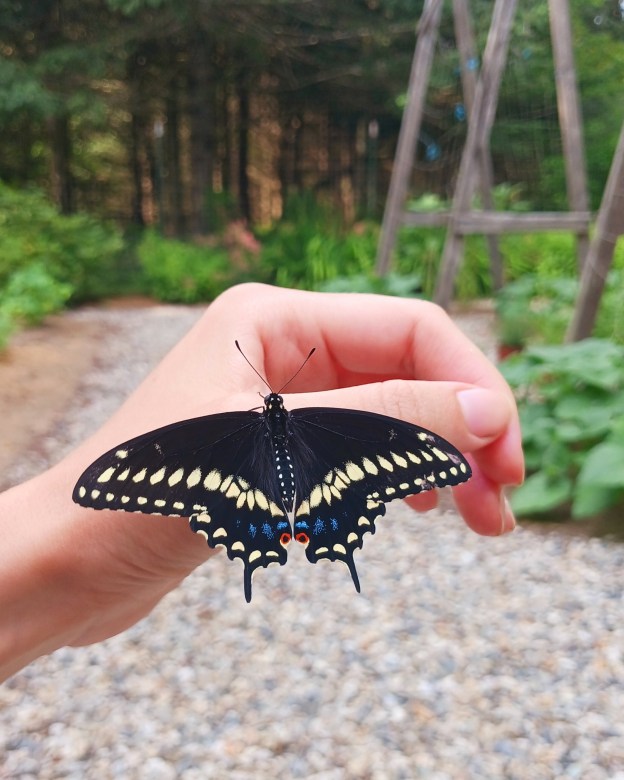
It was soon after I bought the Painted Lady caterpillars (mentioned briefly in my recent post) that I went down to the spring plant sale at the farm and had the tiny baby Eastern Black Swallowtail caterpillars pointed out to me on the dill plants for sale.
I’ll admit that as much as I love dill, the reason I got the dill plants was to try raising these butterfly babies.
The only butterflies that I’d ever raised up until that point had been Painted Ladies, so I was psyched to have another species to watch grow. I will say that at the end of this particular journey, I was very relieved to set them free, because it was a bit of a roller coaster. But I’ll also say that I think I learned a couple things, and I’d probably try it again if I find some more babies next year!
(you can watch the YouTube short that I made about raising them here!)
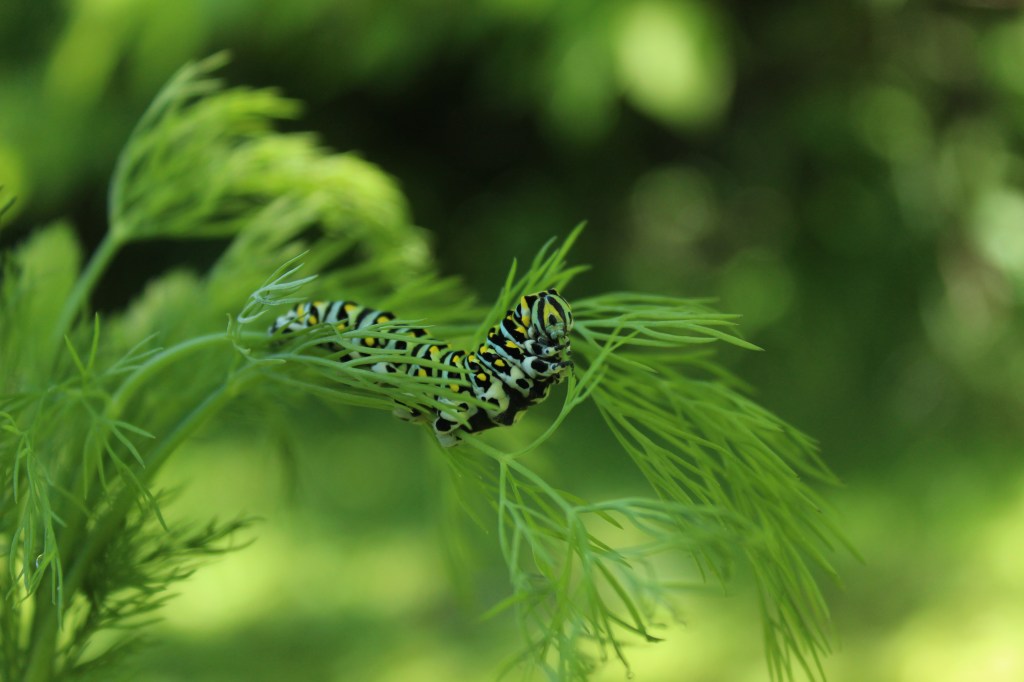
cutest lil face munchin on his dill leaves 🥺
the basics
Eastern Black Swallowtails (Papilio polyxenes) are native to much of the USA, plus a bit of Canada and northern Mexico. They’re good-sized butterflies, with wingspans ranging from 2.5-4 inches.
You can also tell the male and female butterflies apart by the colors on their wings (unfortunately I cannot provide example photos, as all I hatched were males…what the heck!).
Some of their popular host plants (aka where they lay their eggs) are dill, fennel, parsley, and Queen Anne’s Lace. Also, it should be noted that they tend to prefer the plant that they hatch on (so, for example: if you find a caterpillar on fennel, it’ll probably prefer fennel rather than parsley or dill).


these little guys spent much of their lives on our kitchen table, and I thought it was super cute to think about how well they knew us and our voices
When the caterpillars first hatch they’re teeny tiny black or brown blobs, with a white dot in the center of their backs, and little spikes all over their bodies. Eastern Black Swallowtails have five instars (an instar is the phase between two periods of molting), and with every molt they go through, their colors change and develop (and their spikes eventually disappear), until they finally end up being vibrant stripes of neon green and black, with beautiful yellow spots on each segment of their bodies (truly beautiful children).
starting my caterpillar nursery
I zipped my dill plants into some portable mesh butterfly enclosures (here’s a link to the ones that I used), and my small army of ‘pillars was doing incredibly well. I even had a baby appear out of nowhere — because there was clearly a random egg that I’d overlooked! They were growing fast, and it wasn’t long before they started to have an adverse effect on their resident dill plants.
Having hungry little ‘pillars continually munching on a plant does not make for a happy plant.
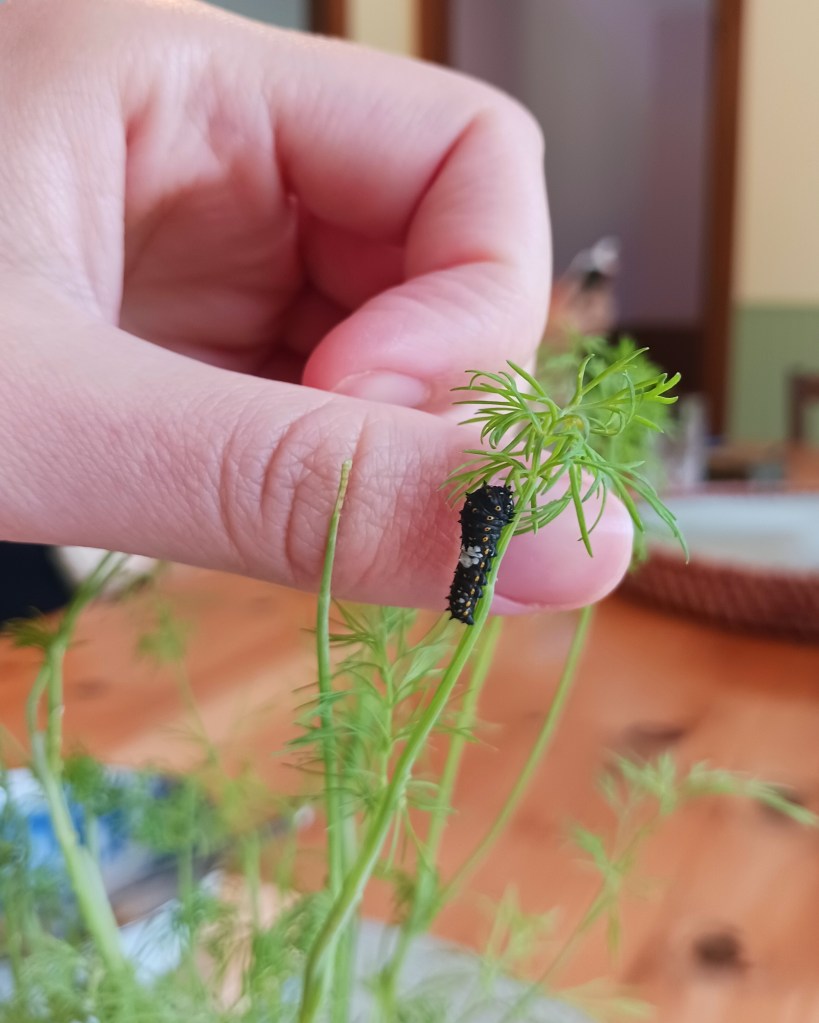
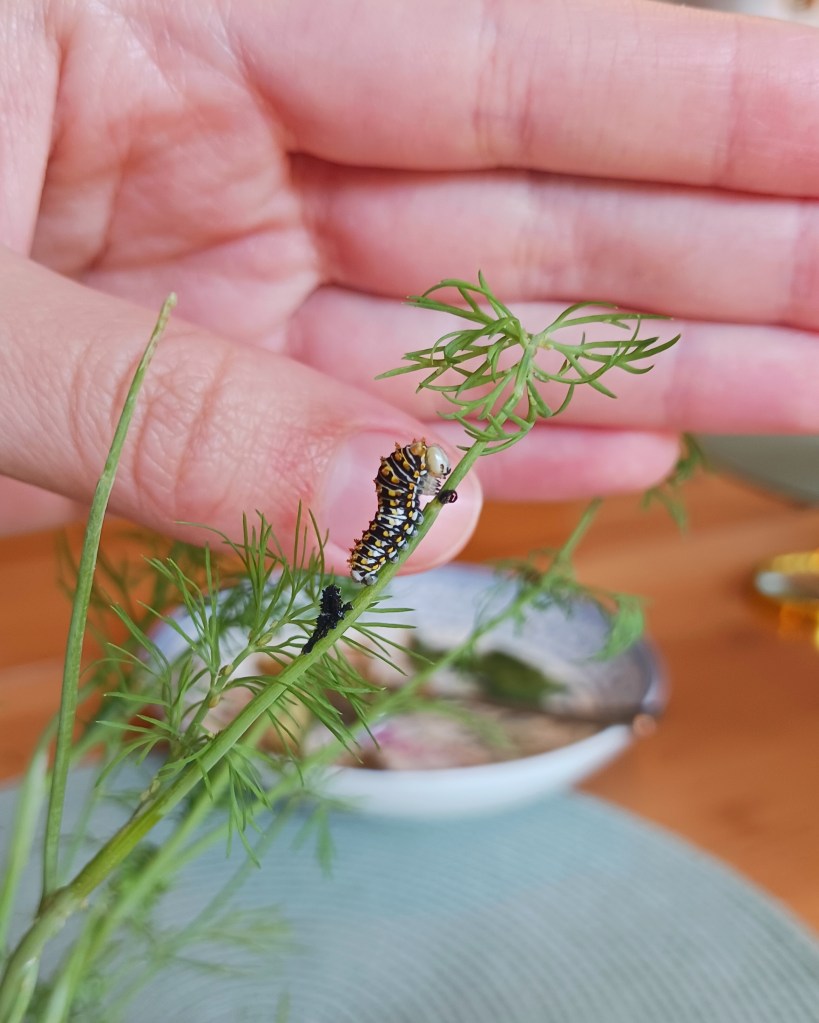
before and after a molt — the head, legs, and spikes darken after they harden again
If I end up raising these guys again next year, I would definitely do this part differently. Instead of keeping the caterpillars on the full plants, I would immediately plant the dill outside, and simply pick stalks of it and bring them inside for my caterpillars to eat. This way the plant would become healthy and established and continue to provide abundant food for the kids as they grow.
Also, an important note: many people that I saw online simply kept the leaves in a tupperware container with the caterpillars, and changed the food every few days when it got too old/dry/wilted. Now, 1. I think the tupperware container is a very sad way to raise caterpillars — give them some fresh air and space!! 2. I found that if I put the dill stalks in a vase of water then it kept them fresh for as long as they needed to be (which isn’t very long when you have growing insects; the dill was inhaled within a day or two).
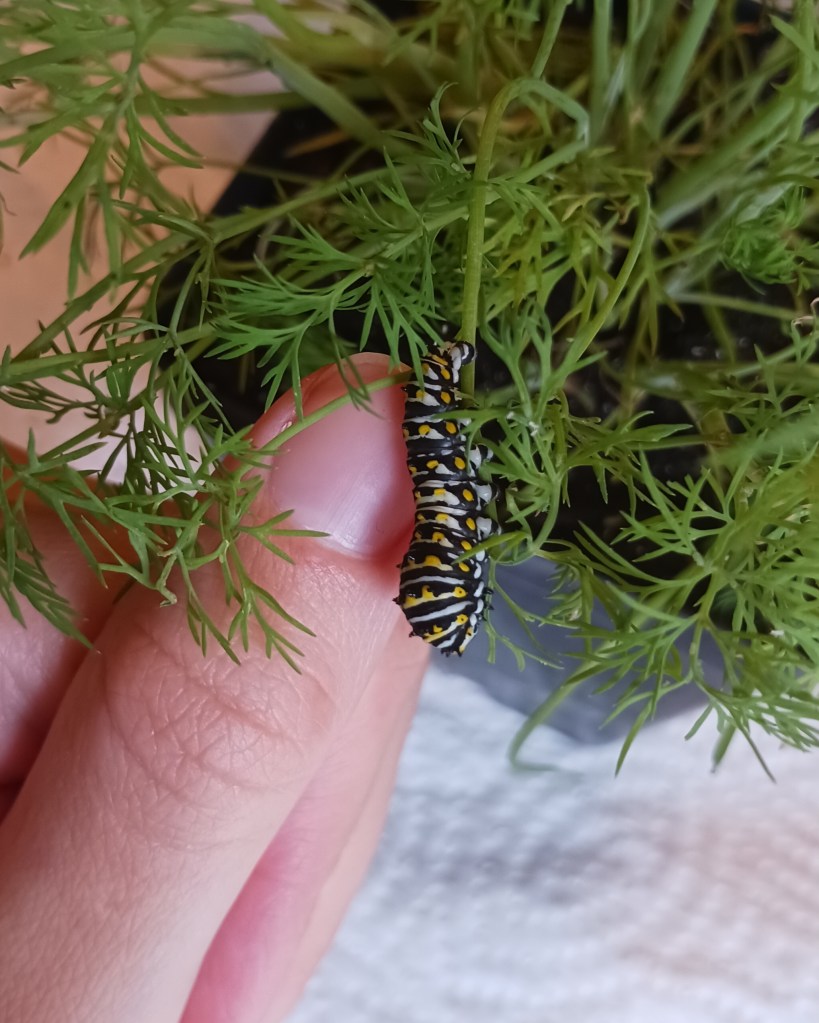
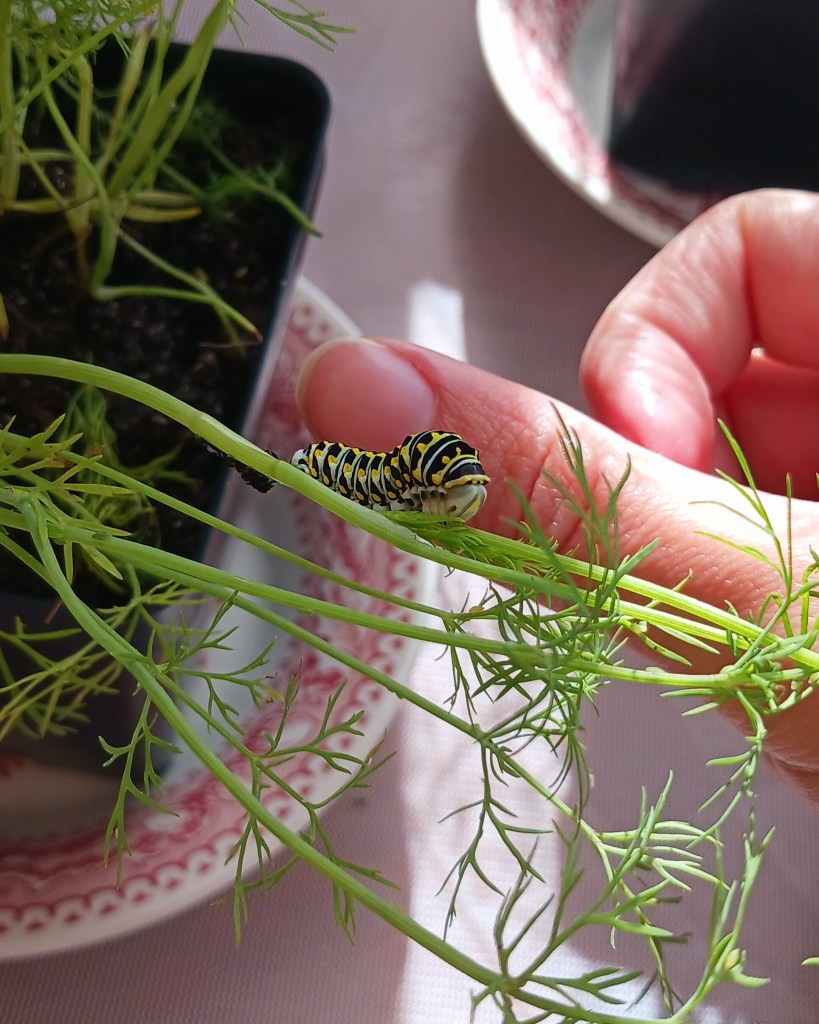
fun fact: these guys have an orange scent gland (called an osmeterium) that looks like two antennae that pop out near their head and emit a strong smell when the caterpillars feel annoyed or threatened; I only saw them a few times because I did my best not to piss off the kids
where i went wrong
Seeing as this was my first time raising these little guys, I just thought that it’d be easier to keep them on their resident plant (I wouldn’t recommend doing this unless you have multiple well-established plants that you can rotate the caterpillars on), so once the dill supply started running low, I thought well it’d be easy to supplement with some organic parsley, and I can’t be sure…but I think this might’ve been where I went wrong.
I done fucked up, y’all.
Because although the caterpillars were not picky, and did seem to enjoy eating the parsley (which was a lot easier to keep fresh than the dill), all of the smallest of my caterpillars seemed to stop growing…and then they eventually got mushy and died.
I can’t say for certain that it was the parsley, perhaps they just failed to thrive…but it was definitely sus.
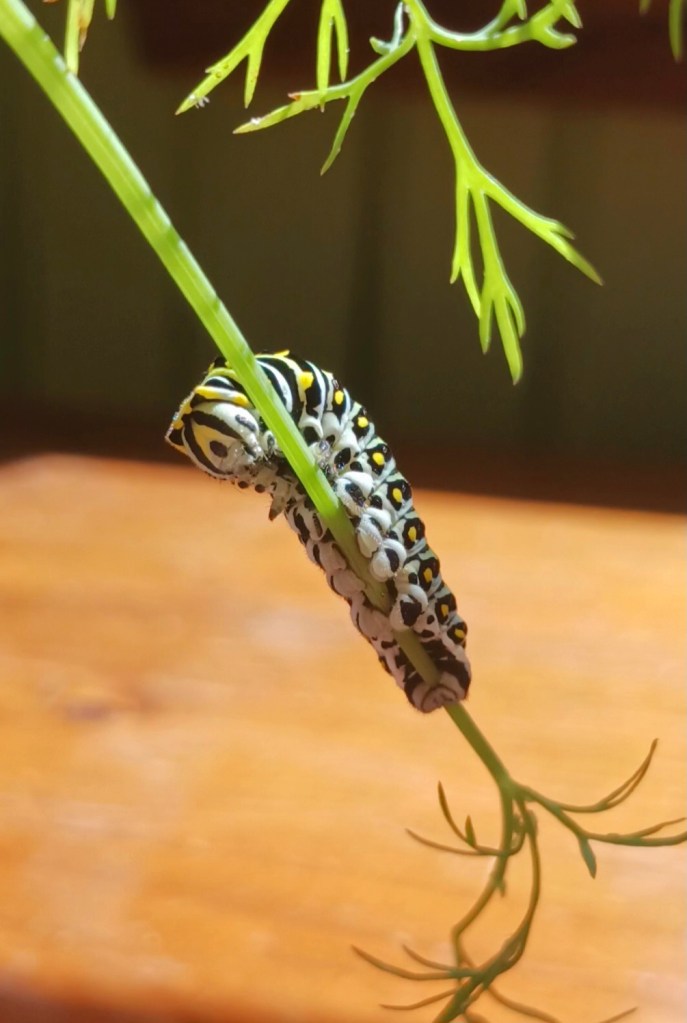
his chunky lil claspers 🥺
We all know that even certified organic vegetables from the grocery story aren’t 100% clean and pure, so maybe there was something on it that had a negative effect on my ‘pillars (I did some googling and found a reddit thread of people who experienced the same problem). But whatever it was, it cut my caterpillar count in half.
A very sad day indeed.
So anyways, if you were to raise Eastern Black Swallowtail butterflies, I would highly recommend continuing to feed them solely from whatever organic host plant you find them on.
Take it from me, who’s lost four young souls ✌🏼😔
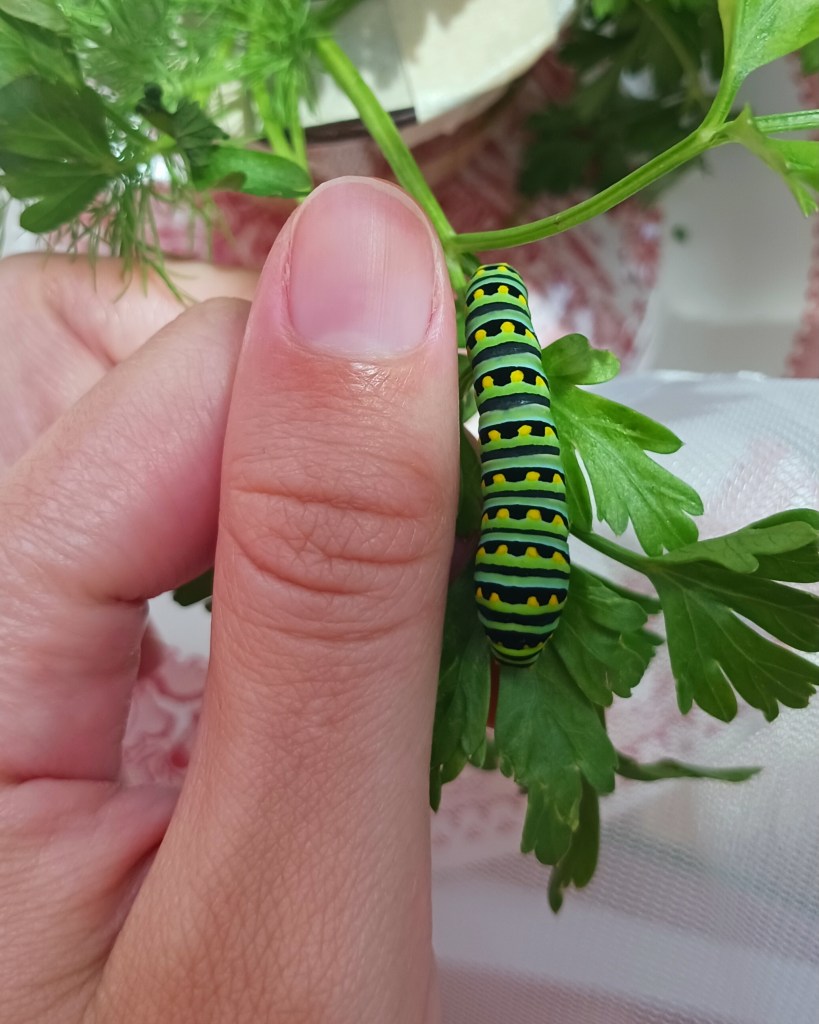
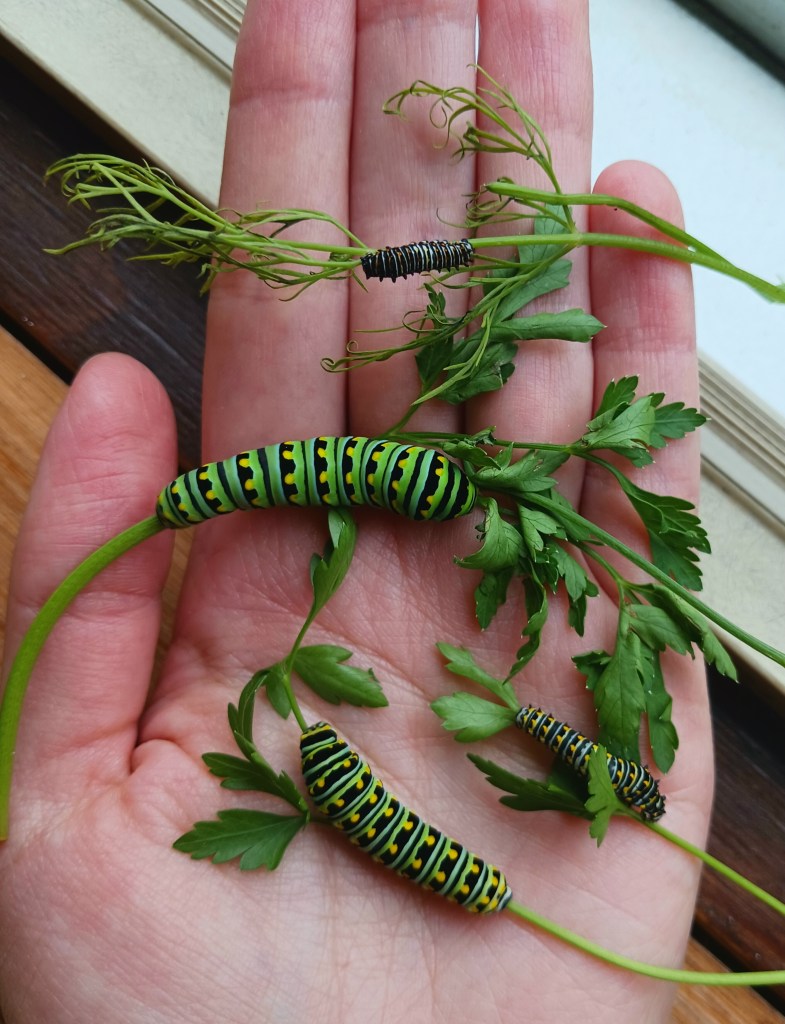
(left) Grover Dill almost at his full size; (right) four children at various stages of development
After I realized what was happening, I immediately made sure to get a couple more dill plants from the farm and plant them outside. They quickly got established and I was able to harvest leaves from them for the rest of my remaining caterpillars (Grover Dill, Dill Pickle, Dillweed, and Dylan), who quickly started growing again.
getting ready to pupate
Once the caterpillars had reached full size (about 2″ long, and thicc as hell), and were ready to pupate, they did a final “purge” where it appeared that they’d straight-up had diarrhea. This is apparently the caterpillar expelling all of the excess food and fluid in its body, and it means that it’s ready to start the next process of development!
At this point, the caterpillars stopped eating altogether, and started wandering around the enclosure, looking for a good place to pupate.

I gave them so many great options, and one still chose to pupate on the wall of the enclosure…kids these days
forming the chrysalis
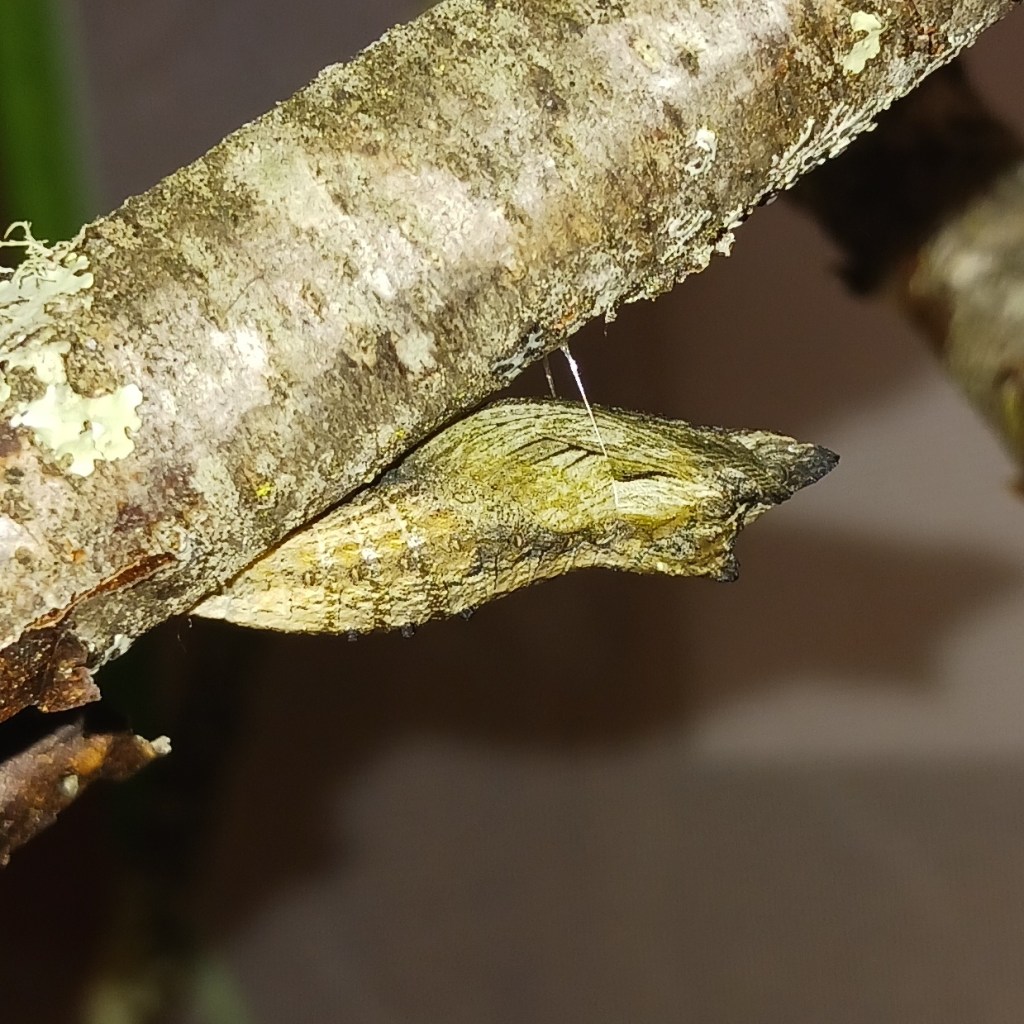
Unlike Painted Ladies and Monarchs, who hang upside-down in their chrysalises, attached to the surface with a very clear stem, the Black Swallowtails have a different method. They attached their little bottoms to whatever surface they choose, and then tether themselves up with a string of silk called a “girdle.”
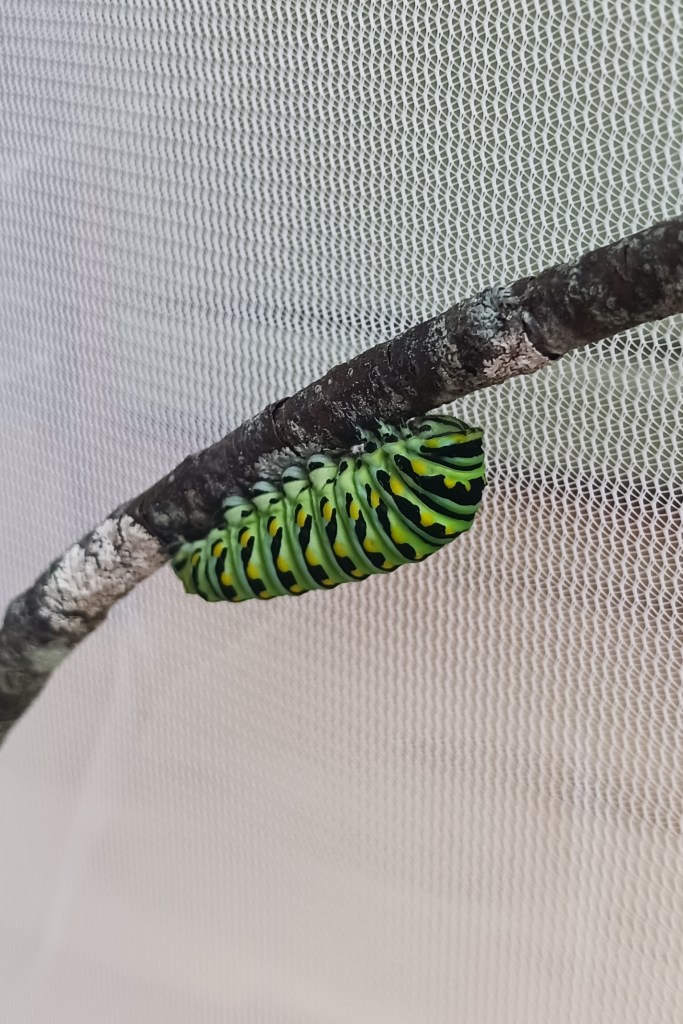
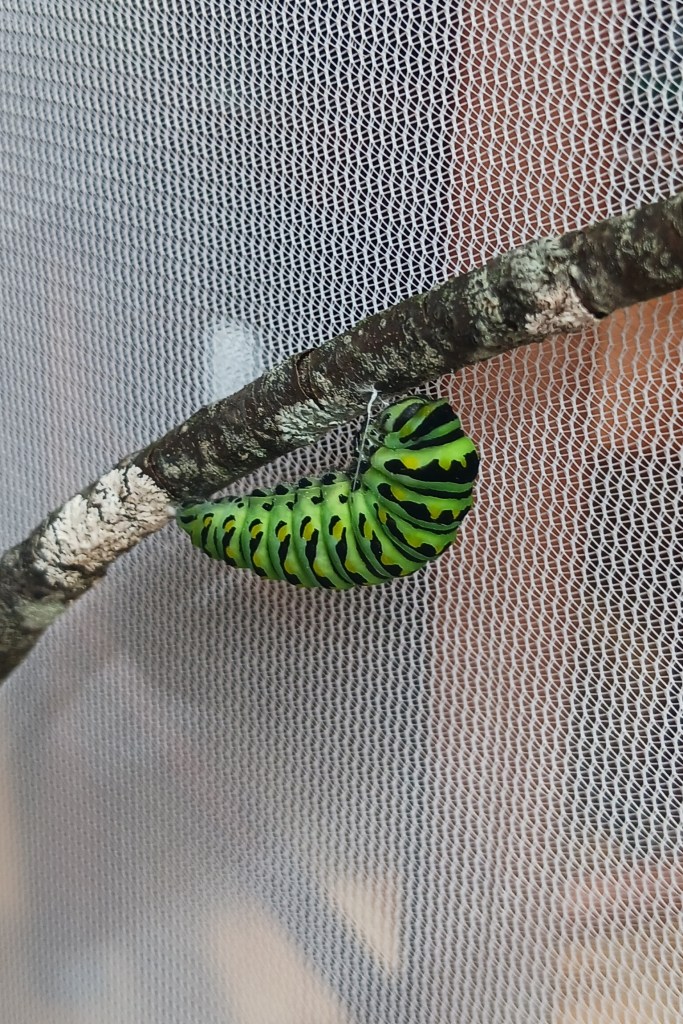

Also, another interesting fact: they often seem to camouflage their chrysalises to their surroundings. So while the three of mine that chose branches to pupate on ended up being a perfect mix of colors that looked nearly identical to the lichen-covered branch, the silly little guy that chose to pupate on the door of the enclosure ended up being bright green — matching the green lining of the enclosure.
Although you’d think that the caterpillar stage was the most stressful part of this process, the problems (unfortunately) did not end there. The pupa stage was not smooth sailing in my little nursery.
Black Swallowtails typically pupate for 10-20 days (unless they’re overwintering, in which case they’ll stay in their chrysalis for months). My three butterflies that hatched, hatched at about the 10 day mark, while one remained unhatched…forever. Grover Dill didn’t make it ✌🏼😔
I’m not sure what happened there, since Grover Dill appeared to be in perfect health, was the first one to make a perfect chrysalis, and was in a perfect spot on a perfect branch.
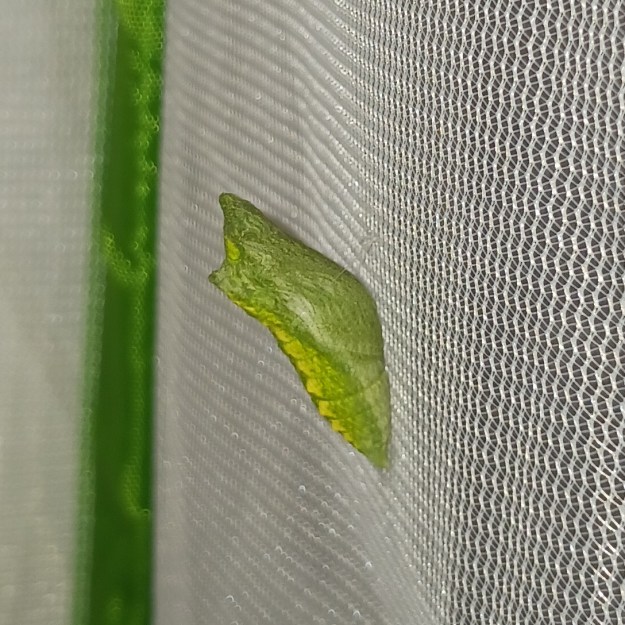
The three that did hatch (Dill Pickle, Dillweed, and Dylan) were all boys, and two (Dill Pickle and Dylan) were successful releases.
Two chrysalises ended up having to be put on a paper towel on the bottom of the enclosure because they either 1. chose a really poor place to pupate, or 2. their girdle ended up breaking. I was assured that plenty of people had them on paper towels and experienced no problems, since when butterflies are born they have a climbing instinct, so they’ll climb up the side of the enclosure and hang upside-down to let their wings properly expand (as all butterflies must do immediately upon hatching).
But the first chrysalis that hatched on the bottom did so while I was out on a hike, and when I returned to a beautifully hatched butterfly, I quickly realized that he had not climbed up the side, and had just let his wings expand the best they could while sitting on the bottom. I’m not sure if he already had problems and was too weak to climb, but for whatever reason, he just sat next to his chrysalis and this resulted in his bottom wings not fully expanding.
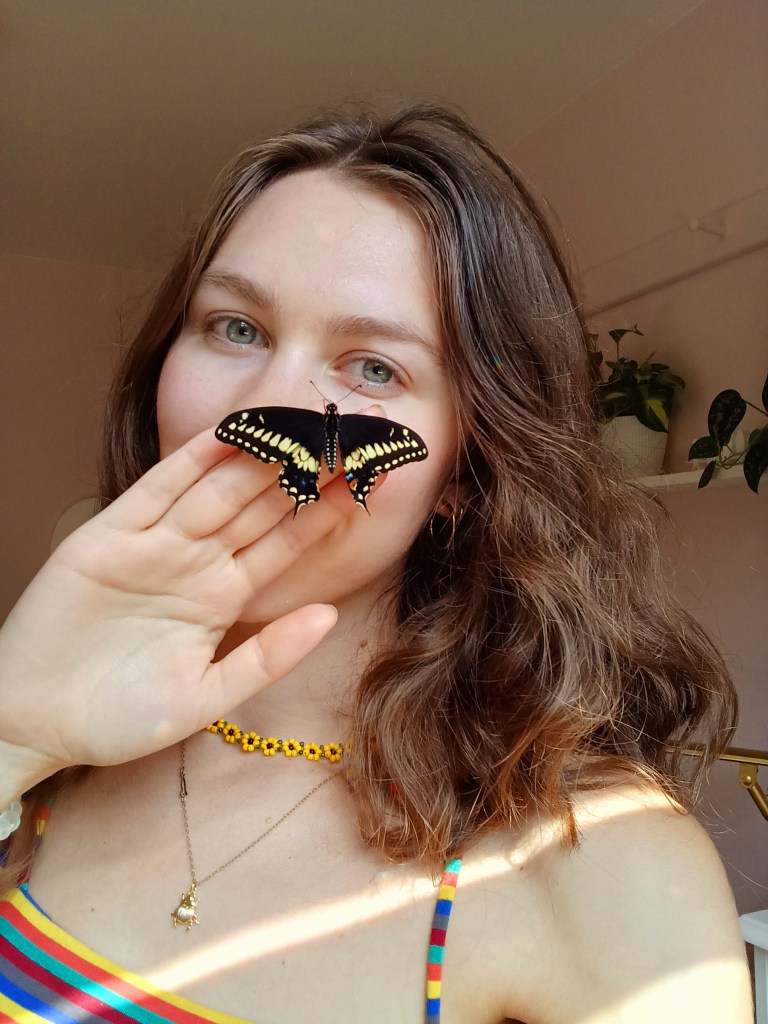
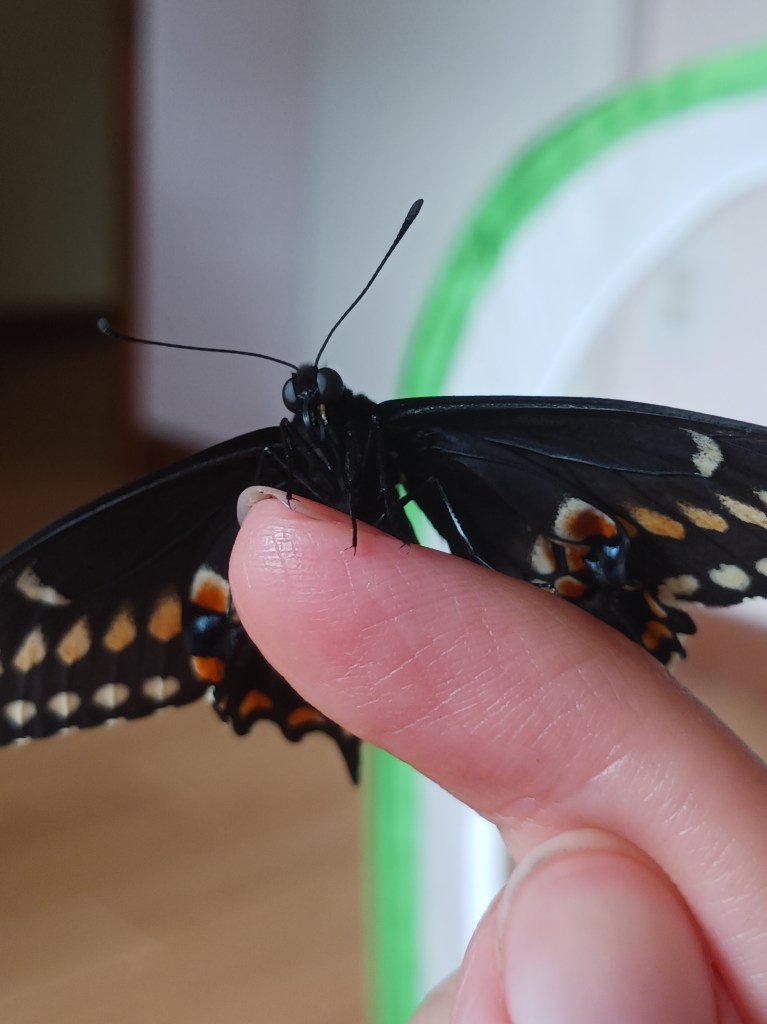
my special lil Dillweed just hangin out 🥺🤍
I hung out with him for a long time in my room, hoping that I’d caught him soon enough to expand the rest of his wings, but unfortunately they were already dry. He fluttered around my room some, drank some nectar, and chilled on my hand for most of the afternoon, but unfortunately he wasn’t strong enough and didn’t thrive, and died the next day while I sat with him outside in the sunshine.
Thankfully I was right nearby when my second paper-towel baby hatched, and although he immediately began working to climb up the side of the enclosure (a strong boi indeed), I gave him a hand — literally — and let him hold onto me while his wings unfurled. It was super special to sit with him and watch the magic happen, and I was definitely relieved to see that he had developed perfectly ✨
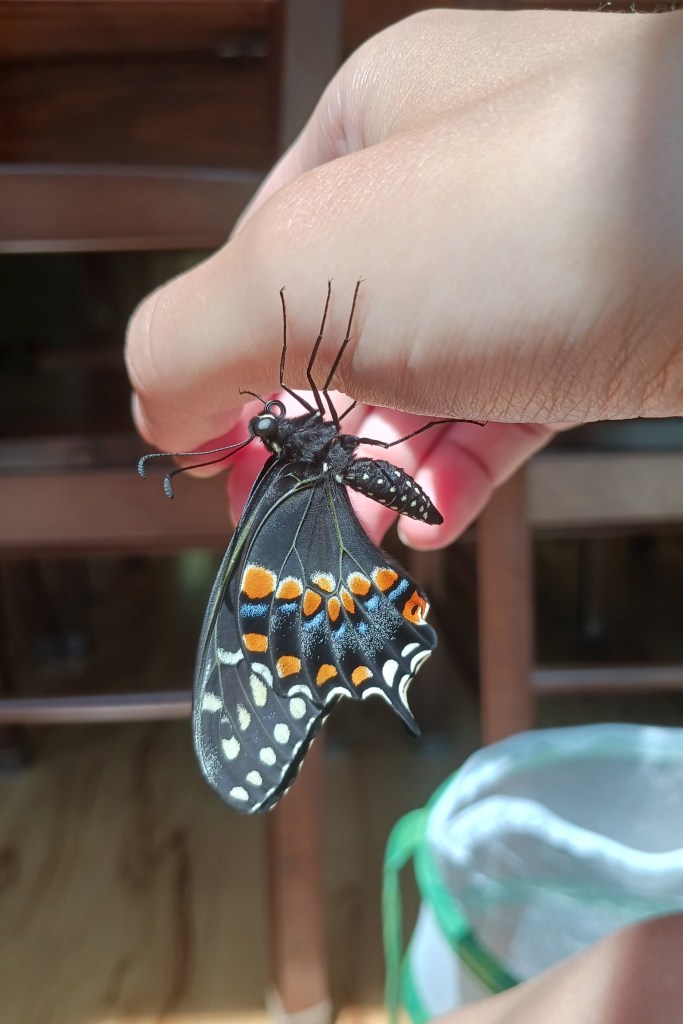

a perfect specimen ✨
You have to keep the butterflies in their enclosure for at least a few hours after they hatch to let their wings thoroughly dry and harden, but after that, I brought both of my happy, healthy boys out to the garden and held them in the sunshine while they acclimated to the big wide world. I then gently coaxed them to fly away, and off they went!
ending thoughts
So as you can see, the journey of the Eastern Black Swallowtails was…an arduous one. And although everyone online says that they’re super easy to raise, that wasn’t my personal experience. But I do know that if I hadn’t taken these guys in, they almost definitely would’ve immediately been picked off by my resident garden birds, since the success rate of these guys (from egg to adulthood) is estimated to be 1-2%.
One to two percent, people!
Seeing those stats made me feel quite good about the beautiful boys that I released back into the wild. I hope they found mates and successfully continued their bloodlines. But if not, they at least got to experience the glory of having wings! ✨
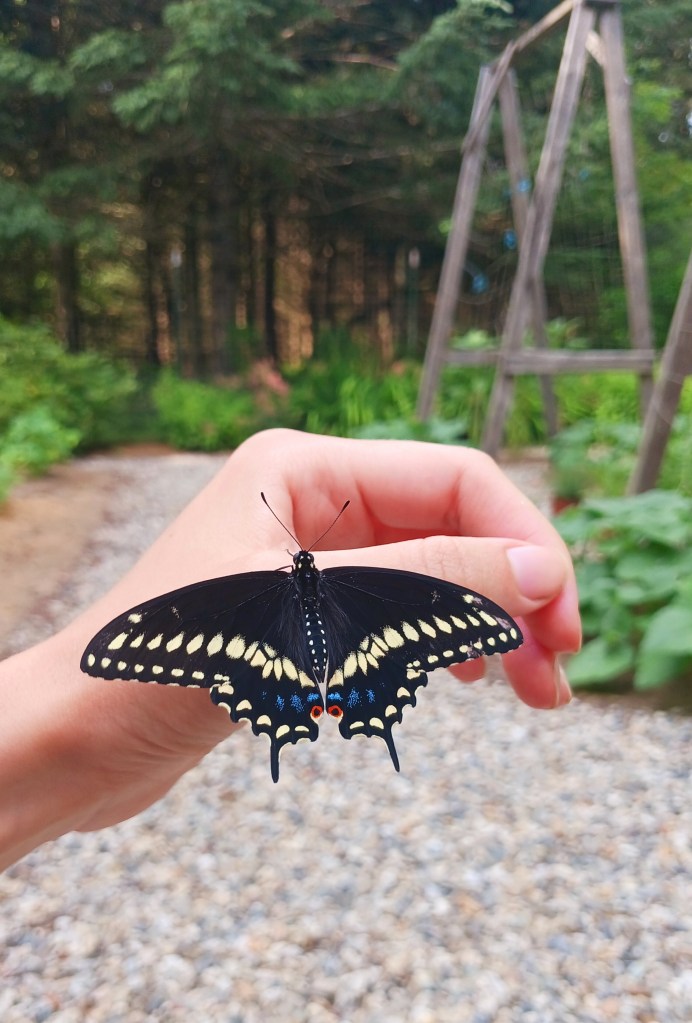
the only time that I’ve ever gotten this close to a butterfly is when I’ve raised them — it just proves that they recognize my voice and presence from all the days they’ve spent with me!
All I can say is that butterflies are a freakin miracle. How do any of them make it to adulthood in the wild?? It’s insanity!!
Although I really couldn’t have done too much differently, and sometimes shit just happens, there are two major notes for next time:
- only feed them from their organic host plant
- tie any fallen chrysalises up so that the butterflies don’t have to climb after hatching
And best of luck to all of us in the spring of 2026 🐛
 art by jordan rae